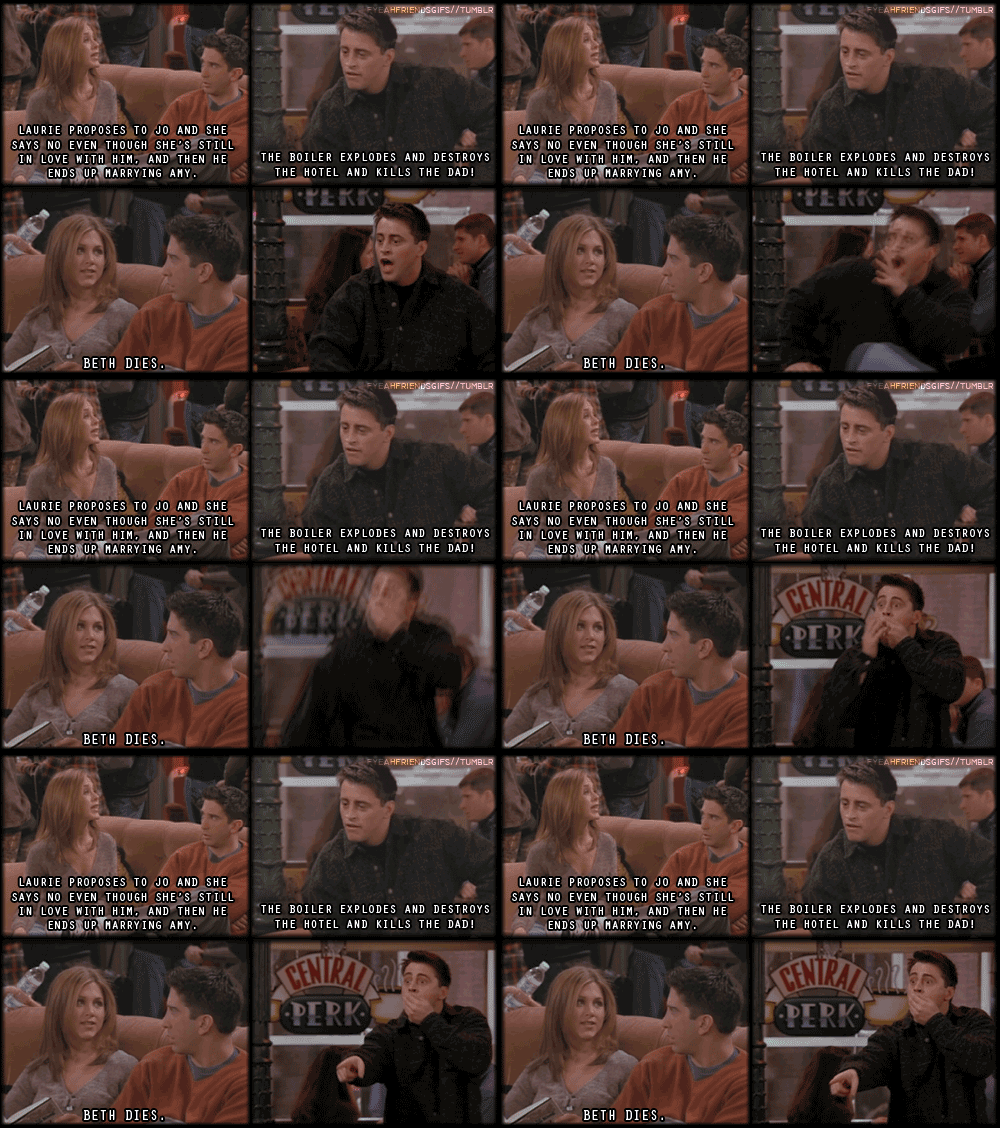
So, you know that episode of Friends where Joey and Rachel switch their favourite books (or, more specifically, the books they've each read more than once), and even though it's not the main storyline of that episode, it's still the bit that I (and probably you, because hey! You're reading a book blog!) remember best from it. The more I think about it, though, the more I really really really love it, only I also kind of doubt its realism, considering the characters involved.
I mean, think about it. It's Joey and Rachel. Has anyone ever seen them read anything, apart from in this episode? I think Joey reads some kind of car magazines sometimes, and Rachel reads, I don't know, Vogue; but there's really not a lot of evidence of any other reading in their lives. Rachel can't even be bothered to read books when she voluntarily signs up for an English class (Remember?! Wuthering Heights and Jane Eyre? Cyborgs?!) and Joey is, well, Joey. He goes into libraries so he can use the bathroom, not so that he can experience the wonders of the reading world. Suffice to say, they're not the most bookish of all the Friends crew (in fact, I'd say, they're the least).
But that's ok, because I guess what they're reading isn't all that deep and difficult- Rachel's favourite book is Little Women, which is presumably a leftover from childhood; and Joey's is The Shining, which is presumably because of the movie, which is, by the way, a mockery of the book, albeit a really good movie on its own ("Chandler: Joey's asking if you've just ruined the only book he's ever loved that didn't star Jack Nicholson."- It disturbs me that I didn't even have to check that quote. Damn.) And, whilst when I watched it the first hundred times, I pretty much decided that Little Women was definitely the best, because The Shining a) sounded scary, and b) was clearly a boy book; now I really don't know whose side I'd be on! Let's face it, they're both awesome.
The episode is riddled with inaccuracies though, mainly because I'm not entirely sure the writers had read The Shining, and had maybe just seen the movie. I'm saying this because they reference the 'All Work and No Play Makes Jack A Dull Boy', which only happens in the movie, and the two dead girls in the hallway, AND he describes the end differently to how it is in the book too. It's a little irritating, but I didn't know any different when I watched it when I was younger. What really did annoy me was the things they said about Little Women- that Laurie marries Amy and that Beth dies! Nonsense, I thought: Amy's still a child when Little Women ends, and Beth is fine- her dad comes home and she's all happy and stuff. I honestly held onto this illusion until I saw the movie like 3 years ago, and I was horrified by the second part of Little Women- I apparently had some idea of how I hoped things would turn out between all the characters, and that just wasn't it! So then I decided to believe the movie was wrong, until I read Good Wives about a year later, and figured out that the two books are probably published together in the US, and so Rachel was right all along. Damn.
Having rewatched this episode, I now realise how little of it this skit takes up (it's literally the third, and I'd say smallest, storyline) and yet it's one that has remained in my imagination a lot longer than the other two, which isn't something I'd often say about Friends. I'm thinking that the combination of them a) talking about books at all, and b) talking about 1, and then later 2, of my favourite books; really made this whole thing stick in my brain, while much more important information was (probably) flying out to wherever such things go. Either way, this remains one of my favourite ever subplots, and its nice to see non-typical readers reading, especially when the books involved are so great. Friends wins at being awesome, yet again!
Wednesday, 8 February 2012
Monday, 6 February 2012
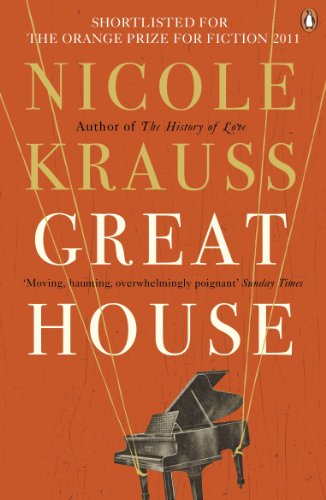
Devouring Books: Great House by Nicole Krauss
I really loved reading this book, and yet I find it difficult to know where to begin talking about it, at all. It's so strange: it's not that I was all that interested in the story (or I should say stories), and I kind of found the premise holding the various stories together flimsy at best, but the writing was so beautiful that it hooked me in and made me want to savour every word. I really don't want to do this (but I'm going to anyway), but the person whose books Krauss most reminds me of is Jonathan Safran Foer, who just happens to be her husband. I choose not to think that they necessarily influence each others work in a straightforward helperly way, but rather they construct stories in similar ways because they're so perfectly suited that they can't not be together! Call me an old romantic if you must, but that's what I choose to believe.
Anyway, for me the similarities end with their wonderful writing style(s), because I really think Krauss knows how to tell a story, whereas Foer's storytelling prowess always leaves me a little... flat. Krauss in fact manages to tell four different stories in this book, and in each of which inspires a sympathy for the characters, and interest in them that really propels you through the book- after the first half, you're left wondering what on earth is going on, and then in the second half, many things are explained that leave a lot of things clearer to you, even though they're still not entirely transparent, even at the end.
What I'm talking about is this. There's this desk, you see, and although you get to follow its progression from characters who are fucked up to various degrees, it's origins remain a little bit confusing even at the very end of the novel. Or, rather, it's origins are clear, but how it got away from them less so, even if we do know where it's been since then. Rather than being frustrating, or detracting from the story, though, you come to see that, the desk isn't really what's important- it's just a piece of furniture. The lives that it is furniture in, though, are much more interesting to learn about and look into, and the way the desk ties them all together is really masterfully done.
My only slight, not complaint, but query about this book is the one section that has nothing to do with the desk at all. I'm not complaining about this part- in fact, it's quite possibly my favourite of all the stories told in the book, concerning an old man and his wayward son, who you think he loves less than his other, easier to decipher son, but then realise that he actually cares SO much about him that it makes him almost bitter with it. So yeah, I really like this part and all, but I'm also kind of like '...but why is in this book?' It's kind of a random inclusion, and I honestly have no answers to it- I'm willing to accept that I liked it so I don't really mind, but at the same time I'm still like 'huh?' (This is partly why I listed this book as one of my top ten book club picks- I NEED to discuss this with other people because I really don't understand how it relates to the other parts, even though I liked it. HELP ME, people!)
Anyway, since without discussion I don't have many intelligent things to say about it, how about some lovely lovely quotes from it? We all love some nice quoting, right, and I couldn't help myself with this book- I was copying out whole pages, chunks of things that seemed really really important at the time, and now probably just seem stupid. Well, let's see!
"I would not pass on a book that I especially loved to another. I am embarrassed to admit this, knowing that it reveals some essential lack or selfishness in my nature, and aware that it runs contrary to the instincts of most, whose passion for something leads them to want to share it, to ignite a similar passion in others, and that without the benefit of such enthusiasm I would still be ignorant of many of the books and much of the music I love most." - This used to be me, but then I started a book blog, so recommending books is all I do!
"Everything about him began to annoy me. The way he whistled in the bathroom, and moved his lips as he read the paper, the way he had to ruin every nice moment by pointing its niceness out."
"Why was it that there was always a unit on history, math, science, and God knows what other useless , totally forgettable information you taught those seventh graders year after year, but there was never any unit on death? No exercises, no workbooks, no final exams on the only subject that matters."
"From a young age, you tirelessly searched for and collected suffering. Of course it isn't that simple. One doesn't choose between the outer and inner life; they co-exist, however poorly. The question is; Where does one place the emphasis?"
"When at last I came across the right book the feeling was violent: it blew open a hole in me that made life more dangerous because I couldn't control what came through it."
"In the next world, we will dwell together in the memory of our memories... We live, each of us, to preserve our fragment, in a state of perpetual regret and longing for a place we only know existed because we remember a keyhole, a tile, the way the threshold was worn under an open door."
Nice, huh? I often find that, the more quotes I've copied out of a book, the less I actually have to say about it, which seems like a weird paradox to me, but, whatever. This book sort of rocks, maybe a tiny bit less than The History of Love, but I loved and adored that book, so this remains really great. I can't imagine a person who wouldn't want to read it after this disturbingly vague review, anyway, so that means we'll all be reading it by tomorrow, yes? Jolly good.
Anyway, for me the similarities end with their wonderful writing style(s), because I really think Krauss knows how to tell a story, whereas Foer's storytelling prowess always leaves me a little... flat. Krauss in fact manages to tell four different stories in this book, and in each of which inspires a sympathy for the characters, and interest in them that really propels you through the book- after the first half, you're left wondering what on earth is going on, and then in the second half, many things are explained that leave a lot of things clearer to you, even though they're still not entirely transparent, even at the end.
What I'm talking about is this. There's this desk, you see, and although you get to follow its progression from characters who are fucked up to various degrees, it's origins remain a little bit confusing even at the very end of the novel. Or, rather, it's origins are clear, but how it got away from them less so, even if we do know where it's been since then. Rather than being frustrating, or detracting from the story, though, you come to see that, the desk isn't really what's important- it's just a piece of furniture. The lives that it is furniture in, though, are much more interesting to learn about and look into, and the way the desk ties them all together is really masterfully done.
My only slight, not complaint, but query about this book is the one section that has nothing to do with the desk at all. I'm not complaining about this part- in fact, it's quite possibly my favourite of all the stories told in the book, concerning an old man and his wayward son, who you think he loves less than his other, easier to decipher son, but then realise that he actually cares SO much about him that it makes him almost bitter with it. So yeah, I really like this part and all, but I'm also kind of like '...but why is in this book?' It's kind of a random inclusion, and I honestly have no answers to it- I'm willing to accept that I liked it so I don't really mind, but at the same time I'm still like 'huh?' (This is partly why I listed this book as one of my top ten book club picks- I NEED to discuss this with other people because I really don't understand how it relates to the other parts, even though I liked it. HELP ME, people!)
Anyway, since without discussion I don't have many intelligent things to say about it, how about some lovely lovely quotes from it? We all love some nice quoting, right, and I couldn't help myself with this book- I was copying out whole pages, chunks of things that seemed really really important at the time, and now probably just seem stupid. Well, let's see!
"I would not pass on a book that I especially loved to another. I am embarrassed to admit this, knowing that it reveals some essential lack or selfishness in my nature, and aware that it runs contrary to the instincts of most, whose passion for something leads them to want to share it, to ignite a similar passion in others, and that without the benefit of such enthusiasm I would still be ignorant of many of the books and much of the music I love most." - This used to be me, but then I started a book blog, so recommending books is all I do!
"Everything about him began to annoy me. The way he whistled in the bathroom, and moved his lips as he read the paper, the way he had to ruin every nice moment by pointing its niceness out."
"Why was it that there was always a unit on history, math, science, and God knows what other useless , totally forgettable information you taught those seventh graders year after year, but there was never any unit on death? No exercises, no workbooks, no final exams on the only subject that matters."
"From a young age, you tirelessly searched for and collected suffering. Of course it isn't that simple. One doesn't choose between the outer and inner life; they co-exist, however poorly. The question is; Where does one place the emphasis?"
"When at last I came across the right book the feeling was violent: it blew open a hole in me that made life more dangerous because I couldn't control what came through it."
"In the next world, we will dwell together in the memory of our memories... We live, each of us, to preserve our fragment, in a state of perpetual regret and longing for a place we only know existed because we remember a keyhole, a tile, the way the threshold was worn under an open door."
Nice, huh? I often find that, the more quotes I've copied out of a book, the less I actually have to say about it, which seems like a weird paradox to me, but, whatever. This book sort of rocks, maybe a tiny bit less than The History of Love, but I loved and adored that book, so this remains really great. I can't imagine a person who wouldn't want to read it after this disturbingly vague review, anyway, so that means we'll all be reading it by tomorrow, yes? Jolly good.
Friday, 3 February 2012
Revisiting Books: Ballet Shoes by Noel Streatfeild
Ballet Shoes was one of my favourite books as a child, I think because, if I was spending time at my nan's house and was heartbreakingly without a book; there was basically only this, or Little Women, (in terms of good books with many words in) to choose from. About half the time I did choose Little Women, and that remains one of my favourite books, but the rest of the time, Ballet Shoes was always there to enchant me. Since my face hurts SO MUCH that I'm finding it difficult to concentrate on reading this week (Netflix, Stephen King, and childrens books only, please) I thought I'd revisit this charming little book to try and make myself feel better.
And, for what it's worth, it totally worked! It obviously wasn't quite as good as I remembered it being from my childhood (because, you know, what is?) but I was still sucked into the story and really felt close to the Fossils and their lives on the stage. I also think I identified many of the things that so appealed to me when I was younger, and, lets face it, still do now. What were these things? I'm so glad you asked, because I have a list all ready and prepared! So, here goes:
1. There's a role for everyone- And I don't mean on the stage. Each of the Fossil 'sisters' is completely different, most obviously in looks (you've got your blonde, dark haired, and redheaded girl) but also in everything else too- their ambitions differ, their attitudes are so diverse, and the things each of them ends up doing are so different. Right at the end of the book, Petrova says "I wonder which of us the other girls would choose to be", and yeah, it's a bit hit-you-over-the-head obvious, but at the same time, you've probably been thinking while you've been reading (if you're anything like 8 year old me) 'ooh, I wish I was...' In case you're interested, I probably wanted to be the blonde, beautiful actress Pauline when I was little, but now I'd probably rather be Petrova, because she's really the most interesting, at least in my opinion.
2. There are many celebrations- And when I say celebrations, what I'm really talking about is presents! I have always always loved it in books when it's Christmas and the characters all get presents, and I have no idea why- it's just something I love! And, there are ample opportunities for that in this book- I think a couple of Christmases are described in detail, as well as birthdays plus a few opportunities for present giving after the girls have performed in shows. I don't know why I get such pleasure out of characters in books getting imaginary presents, but I really really do!
3. The Money- This book is set in 1930s England, and there's a lot of opportunities to discuss pounds and shillings and whatnot, and I get such a kick out of that, possibly because it reminds me of a LOT of my childhood reading (Enid Blyton and all that). Because the girls all work in the theatre, they get paid, and then the money has to be allocated out; and reading about the way it is split somehow interests and excites me (maybe when I was younger because I liked maths a lot? I have no idea...). It also helped that they didn't really have much money to live on, and so had to take austerity measures and take very good care of their money, which for me was always something really interesting to read about.
4. The Stage- I used to want to be an actress when I was younger, so the concept of going to auditions, and wearing nice clothes to do so definitely appealed to me! I feel like a lot of this book is about the practicalities of children working in the theatre (having to obey child labour laws, for instance) and so I probably thought of it as a kind of guidebook on how to become a Child Star. Not that I ever did, of course. *SOB*
5. The Way They Live- The Fossils live in a big London house, and instead of having parents, they have a guardian, a Nanny, a cook, a maid, and a whole host of interesting and exciting lodgers. I lived with my mum, dad, and sister, so guess whose lives sounded way more exciting? The girls didn't even have to go to school-school, only stage school, and the rest they learned at home, including (which I find more impressive now) learning Shakespeare from actual Shakespeare scholars! To be honest, their lives sounded like the most exciting ones in the world.
Basically, I loved, and still love, most things about this book. If you read it while you were younger, you'll probably know what I'm talking about, but if you didn't, there's probably not much point in reading it now- I think of this as one of those books that captivate your imagination when you're young, and so you'll love it forever; whereas if you read it when you're older, all that magic just doesn't really appear. It's the reason I think I've seen so many negative reviews of Little Women floating around, because its charms are lost once you're past a certain age, but if you're below a certain age when you first read it, you will love it forever. I think we all have books like that, and I'm certainly glad that I do.
And, for what it's worth, it totally worked! It obviously wasn't quite as good as I remembered it being from my childhood (because, you know, what is?) but I was still sucked into the story and really felt close to the Fossils and their lives on the stage. I also think I identified many of the things that so appealed to me when I was younger, and, lets face it, still do now. What were these things? I'm so glad you asked, because I have a list all ready and prepared! So, here goes:
1. There's a role for everyone- And I don't mean on the stage. Each of the Fossil 'sisters' is completely different, most obviously in looks (you've got your blonde, dark haired, and redheaded girl) but also in everything else too- their ambitions differ, their attitudes are so diverse, and the things each of them ends up doing are so different. Right at the end of the book, Petrova says "I wonder which of us the other girls would choose to be", and yeah, it's a bit hit-you-over-the-head obvious, but at the same time, you've probably been thinking while you've been reading (if you're anything like 8 year old me) 'ooh, I wish I was...' In case you're interested, I probably wanted to be the blonde, beautiful actress Pauline when I was little, but now I'd probably rather be Petrova, because she's really the most interesting, at least in my opinion.
2. There are many celebrations- And when I say celebrations, what I'm really talking about is presents! I have always always loved it in books when it's Christmas and the characters all get presents, and I have no idea why- it's just something I love! And, there are ample opportunities for that in this book- I think a couple of Christmases are described in detail, as well as birthdays plus a few opportunities for present giving after the girls have performed in shows. I don't know why I get such pleasure out of characters in books getting imaginary presents, but I really really do!
3. The Money- This book is set in 1930s England, and there's a lot of opportunities to discuss pounds and shillings and whatnot, and I get such a kick out of that, possibly because it reminds me of a LOT of my childhood reading (Enid Blyton and all that). Because the girls all work in the theatre, they get paid, and then the money has to be allocated out; and reading about the way it is split somehow interests and excites me (maybe when I was younger because I liked maths a lot? I have no idea...). It also helped that they didn't really have much money to live on, and so had to take austerity measures and take very good care of their money, which for me was always something really interesting to read about.
4. The Stage- I used to want to be an actress when I was younger, so the concept of going to auditions, and wearing nice clothes to do so definitely appealed to me! I feel like a lot of this book is about the practicalities of children working in the theatre (having to obey child labour laws, for instance) and so I probably thought of it as a kind of guidebook on how to become a Child Star. Not that I ever did, of course. *SOB*
5. The Way They Live- The Fossils live in a big London house, and instead of having parents, they have a guardian, a Nanny, a cook, a maid, and a whole host of interesting and exciting lodgers. I lived with my mum, dad, and sister, so guess whose lives sounded way more exciting? The girls didn't even have to go to school-school, only stage school, and the rest they learned at home, including (which I find more impressive now) learning Shakespeare from actual Shakespeare scholars! To be honest, their lives sounded like the most exciting ones in the world.
Basically, I loved, and still love, most things about this book. If you read it while you were younger, you'll probably know what I'm talking about, but if you didn't, there's probably not much point in reading it now- I think of this as one of those books that captivate your imagination when you're young, and so you'll love it forever; whereas if you read it when you're older, all that magic just doesn't really appear. It's the reason I think I've seen so many negative reviews of Little Women floating around, because its charms are lost once you're past a certain age, but if you're below a certain age when you first read it, you will love it forever. I think we all have books like that, and I'm certainly glad that I do.
Thursday, 2 February 2012
Devouring Films: Wal*Mart: The High Cost of Low Price
Before I even begin complaining about how terrible Wal*Mart* is, can I just say that I kind of really want to go to one? I mean, I disagree with basically everything about them, their policies, what they do with the ginormous profits they make, the freaking ugly look of them, BUT just purely as a tourist thing, I kind of want to go into a cavernous shop, just to see what it's like! I've only ever been to New York City in America, where there is no Wal*Mart (mainly because there's literally no space, I'm assuming), but I'm pretty sure it's something to be experienced. Just, not late at night in one of their car parks, because, oh yeah, you might get attacked and they won't give even the tiniest shit about it. We are, in the UK, the proud beneficiaries of sister-company Asda, which I really really hate because they have the worst variety of any supermarket, and I pretty much had to shop there when I was at University because there were no other supermarkets anywhere near. Stupid Wal*Mart.
So, I really enjoyed this documentary which I've been meaning to watch for years but never got round to til I got Netflix AND had my wisdom teeth out around the same time. I was well aware that I would be completely horrified by their business practices, but about now, I'm kind of horrified at the way the government acts (or I should say acted- this was made in 2005, so I'm not sure how things are now: Probably worse, but there's always the chance that they're better) towards Wal*Mart. Specifically: local governments subsidise the building of Wal*Marts in their local area, a stunningly unnecessary move that benefits approximately 3 people, and all of them Waltons, heirs of the original owner of Wal*Mart. Why is it unnecessary? Wal*Mart are (or again, possibly were) the largest corporation in the world, earning more than enough money to build their own damn stores; and yet they were being enticed into areas with all this extra money just so local economies could be completely decimated. Not cool, local governments. At all.
So, you'd think with all their money taken away from schools and other public services, Wal*Mart could afford to give a little money to charity, right? Well, the Waltons had, as of 2005, donated less than 1% of their wealth to charity. Bill Gates? Has donated 58%, and he's still an extremely rich man. EXTREMELY. (I love Bill Gates by the way. Just so we're all aware). But, ok, fair enough, maybe they want to keep their money. That's fine (sort of). But with the massive profits Wal*Mart make every year, they could definitely pay their workers enough money to live off, right? Well, not exactly- Wal*Mart employees don't earn enough to pay for the company health insurance, for daycare, or, basically, for anything other than food and utilities, and sometimes not even that. Wal*Mart, in fact, actively encourage employees to go through government schemes so they can get the stuff they need, just so Wal*Mart doesn't have to provide it for them. Just another way they're swindling tax dollars out of the US Government.
That wasn't even the most upsetting part of the documentary, though I kind of wish it was. Most upsetting is split between the small business owner of 40 years who had to shut down because a Wal*Mart moved in up the road, just because his son and granddaughter were crying about how much they loved the business, and also because of how he said that he really got to know and care about all his employees. I mean, does anyone care about their employees anymore, because all of these massive corporations that I think all of us support in one way or another sure as hell don't. Marginally more upsetting though, was listening to the state of the conditions that workers in China and Bangladesh have to go through just to make cheap shit for Western consumers to buy. I get extremely uncomfortable even thinking about it, because of course I buy some of this cheap shit, and I am, in part, responsible for the subjugation of millions, and maybe even more (tens of millions? Billions?) living breathing human beings. Should they really have to work their entire lives, or at least their entire youths away so that we can buy a really really cheap jumper? Of course not, and we all agree with that, only we're still buying that jumper because there's a complete disconnect between a product's origins, and how it is when we see it in a shop. Like I say, it's not something I am physically able to think about a lot, because it just makes me sick and I literally don't know what to do about it, on a wider scale than just me not buying it.
That is, of course, something that's absolutely not exclusive to Wal*Mart, although as the documentary says, as the largest corporation in the world, they have to set the standard for good working practices and everyone else will follow suit. Doesn't sound too hard, but apparently it is, because, hey, it's all about the money! The bottom line is: The cheaper they can get the product, the greater profit they can make on it, and the more money they can put into their own pockets and not pay their workers. They don't care about the consumer, they don't care about their workers, they literally just care about their profits, and, again, they're far from being alone in this. Everyone does it, and until people stand up and say they want things to change, nothing will. It never used to be like this- something I vividly remember from a Michael Moore documentary is his saying how his dad used to work at the General Motors factory in Michigan, and how their aim was for every worker to be able to afford one of their cars (along with having a good standard of living, enough food to eat and all that jazz), and I just thought, well, where have companies like that gone? Why is it all about making as much money as you possibly can without sharing the wealth now, and why do we stand for it? I blame the 80s, personally, but I blame the 80s for everything.
Anyway. Wal*Mart is evil, yes we know. I think this is a really good documentary for someone who really isn't aware of all the shitty thing Wal*Mart do (and I really wasn't aware of all of them, by any means) and just provides so much evidence (SO many interviews) for the cases it makes. It's also, I think, pretty well made- they do a good job of cutting in adverts where Wal*Mart have made outrageous claims (like caring about the environment! HA!) and then providing cases where they clearly haven't followed through on, well, any of these claims. I also like the fact that it ends on a positive note, highlighting cases where people have defeated Wal*Marts being built in their local areas, and, although 7 years later they're still going strong, at least we know they can be defeated, however small each victory may seem. Because don't get me wrong- even though I want to visit Wal*Mart as a kind of tourist destination, I'd be much happier seeing them go out of business, with a whole load of wonderfully ethical and fair businesses taking their place**. I can dream, right?
*I know it's just Walmart now (at least according to Wikipedia) but I like to use the star key, so shh!
**Because, you know, I don't want people to lose their jobs or anything, even if they are shitty shitty jobs- in Laura's imagination world, these new ones are much much better.
So, I really enjoyed this documentary which I've been meaning to watch for years but never got round to til I got Netflix AND had my wisdom teeth out around the same time. I was well aware that I would be completely horrified by their business practices, but about now, I'm kind of horrified at the way the government acts (or I should say acted- this was made in 2005, so I'm not sure how things are now: Probably worse, but there's always the chance that they're better) towards Wal*Mart. Specifically: local governments subsidise the building of Wal*Marts in their local area, a stunningly unnecessary move that benefits approximately 3 people, and all of them Waltons, heirs of the original owner of Wal*Mart. Why is it unnecessary? Wal*Mart are (or again, possibly were) the largest corporation in the world, earning more than enough money to build their own damn stores; and yet they were being enticed into areas with all this extra money just so local economies could be completely decimated. Not cool, local governments. At all.
So, you'd think with all their money taken away from schools and other public services, Wal*Mart could afford to give a little money to charity, right? Well, the Waltons had, as of 2005, donated less than 1% of their wealth to charity. Bill Gates? Has donated 58%, and he's still an extremely rich man. EXTREMELY. (I love Bill Gates by the way. Just so we're all aware). But, ok, fair enough, maybe they want to keep their money. That's fine (sort of). But with the massive profits Wal*Mart make every year, they could definitely pay their workers enough money to live off, right? Well, not exactly- Wal*Mart employees don't earn enough to pay for the company health insurance, for daycare, or, basically, for anything other than food and utilities, and sometimes not even that. Wal*Mart, in fact, actively encourage employees to go through government schemes so they can get the stuff they need, just so Wal*Mart doesn't have to provide it for them. Just another way they're swindling tax dollars out of the US Government.
That wasn't even the most upsetting part of the documentary, though I kind of wish it was. Most upsetting is split between the small business owner of 40 years who had to shut down because a Wal*Mart moved in up the road, just because his son and granddaughter were crying about how much they loved the business, and also because of how he said that he really got to know and care about all his employees. I mean, does anyone care about their employees anymore, because all of these massive corporations that I think all of us support in one way or another sure as hell don't. Marginally more upsetting though, was listening to the state of the conditions that workers in China and Bangladesh have to go through just to make cheap shit for Western consumers to buy. I get extremely uncomfortable even thinking about it, because of course I buy some of this cheap shit, and I am, in part, responsible for the subjugation of millions, and maybe even more (tens of millions? Billions?) living breathing human beings. Should they really have to work their entire lives, or at least their entire youths away so that we can buy a really really cheap jumper? Of course not, and we all agree with that, only we're still buying that jumper because there's a complete disconnect between a product's origins, and how it is when we see it in a shop. Like I say, it's not something I am physically able to think about a lot, because it just makes me sick and I literally don't know what to do about it, on a wider scale than just me not buying it.
That is, of course, something that's absolutely not exclusive to Wal*Mart, although as the documentary says, as the largest corporation in the world, they have to set the standard for good working practices and everyone else will follow suit. Doesn't sound too hard, but apparently it is, because, hey, it's all about the money! The bottom line is: The cheaper they can get the product, the greater profit they can make on it, and the more money they can put into their own pockets and not pay their workers. They don't care about the consumer, they don't care about their workers, they literally just care about their profits, and, again, they're far from being alone in this. Everyone does it, and until people stand up and say they want things to change, nothing will. It never used to be like this- something I vividly remember from a Michael Moore documentary is his saying how his dad used to work at the General Motors factory in Michigan, and how their aim was for every worker to be able to afford one of their cars (along with having a good standard of living, enough food to eat and all that jazz), and I just thought, well, where have companies like that gone? Why is it all about making as much money as you possibly can without sharing the wealth now, and why do we stand for it? I blame the 80s, personally, but I blame the 80s for everything.
Anyway. Wal*Mart is evil, yes we know. I think this is a really good documentary for someone who really isn't aware of all the shitty thing Wal*Mart do (and I really wasn't aware of all of them, by any means) and just provides so much evidence (SO many interviews) for the cases it makes. It's also, I think, pretty well made- they do a good job of cutting in adverts where Wal*Mart have made outrageous claims (like caring about the environment! HA!) and then providing cases where they clearly haven't followed through on, well, any of these claims. I also like the fact that it ends on a positive note, highlighting cases where people have defeated Wal*Marts being built in their local areas, and, although 7 years later they're still going strong, at least we know they can be defeated, however small each victory may seem. Because don't get me wrong- even though I want to visit Wal*Mart as a kind of tourist destination, I'd be much happier seeing them go out of business, with a whole load of wonderfully ethical and fair businesses taking their place**. I can dream, right?
*I know it's just Walmart now (at least according to Wikipedia) but I like to use the star key, so shh!
**Because, you know, I don't want people to lose their jobs or anything, even if they are shitty shitty jobs- in Laura's imagination world, these new ones are much much better.
Wednesday, 1 February 2012
Devouring Stephen King: Skeleton Crew
Skeleton Crew is the second selection of Stephen King short stories I've reviewed, and still I don't have a clue how to do it. I'll start here though: I have such a rough time reading books of short stories, or rather getting started on reading them, and who know why? Well, Stephen King does of course:
"PEOPLE ARE LAZY." (Thanks to Kayleigh for alerting me to this video!) He's so right, at least in my case! It's funny though, because even though it probably took me about 3 weeks to read the first, say, 5 mini chapters of The Mist (technically a novella, so I question its presence here!), once I got going, I read the whole thing (606 pages and 22 stories) in like 3 days. Go figure.
I guess it's because really, when you get right down to it, I do kind of love Stephen King's short stories. They allow him to branch out from pure horror, and move into Sci-Fi, Crime, Thriller and even poetry, although the less said about that, the better. All in all, it's a pretty great selection, and the majority of the stories I did find really engaging, AND I would say, some of them were genuinely scary. I don't know whether this was just because I hadn't read them before (as opposed to say, The Shining, which is scary, but was much less so when I read it and reviewed it here) or because there's something special about the short story that means King can go way further into the depths of scarytown, population: me. And also, I don't know if you know this, but most Stephen King novels have a happy ending, and by happy, I mean the threat is eliminated, and at least a couple of the characters you love are still alive. He doesn't do this so much with his short stories, which makes them a lot more bleak, and, by extension, much, much scarier.
Since I really don't know what to do with short story reviewing, allow me to pick out some of my favourites and the few stories that I didn't really like (there are very few, I might add). So, my favourites:
The Mist: I probably haven't been so scared by a story since the first time I read It, and that's saying something. There's so much tension and fear and horror, all extremely finely tuned and brilliantly punctuated with moments of true horror. I'm now a littletinybit afraid of fog, so that's probably something I'm going to have to work on.
The Monkey: I was also genuinely scared by this story, about a toy that comes alive, making people die whenever it crashes its cymbals together. A horrible horrible notion, but I was mostly afraid of the description of the toy itself (SO CREEPY), as well as leftover childhood fears that my toys would come alive at night (did anyone find that an appealing notion?! I mean, I'm not saying that I think Toy Story is a horror movie or anything, but the thought of it actually happening in front of my eyes actually terrified me). So yeah. Scary scary stuff!
The Jaunt: A kind of history of the teleporter, combined with a twist ending that I definitely saw coming but was still somehow really really shocking. More of a sci-fi than horror story, but that ending was definitely horrible!
Word Processor of the Gods: Plays with the emergence of new technology in the early 80s, by imagining a computer that can delete and insert actual things into the real life world. I didn't find this one scary either (I guess it's more of a Bachman short story), but I did think it was really clever, and almost cleverer considering how new computers were at the time.
The Man Who Would Not Shake Hands: Honestly, I just liked this one because it returned to that really creepy club depicted in The Breathing Method, BUT it was also kind of creepy without being to overtly scary. Nona, which I didn't like nearly as much, also gets points for including characters out of The Body. (There are also many references to Cujo in a few of these stories, and I do so love the whole StephenKingosphere!)
Gramma- This is a really, seriously scary story, all windy and witchcrafty and atmospheric, and I'm kind of afraid of being left alone with old ladies now. Really.
The only ones I didn't really like:
Beachworld: Not all that much really happened, and it was way too sci-fi for me- all set in the future and spacemen and androids, and I didn't really need all that stuff when you're not going to craft a story properly. Not his best.
The Wedding Gig: This was fully a mafia-style story, only it wasn't nearly as exciting, and despite the slight twist ending, it didn't really grab my interest. I think I may have missed the point though...
The Reach: I might have just disliked this one because I really really wanted to finish, but it was sort of boring- just a few ghosts and an old lady with unfulfilled ambitions. I didn't really care, to be honest.
So, that's my general verdict! Like I say, the majority of the stories were super-awesome, and I haven't even told you about the typewriter elves in The Ballad of the Flexible Bullet, or this really really really disgusting death in The Raft. It's definitely worth giving this collection a go, even if, like me, you're too lazy to read short stories. Just think, it's less than half the size of The Stand...
"PEOPLE ARE LAZY." (Thanks to Kayleigh for alerting me to this video!) He's so right, at least in my case! It's funny though, because even though it probably took me about 3 weeks to read the first, say, 5 mini chapters of The Mist (technically a novella, so I question its presence here!), once I got going, I read the whole thing (606 pages and 22 stories) in like 3 days. Go figure.
I guess it's because really, when you get right down to it, I do kind of love Stephen King's short stories. They allow him to branch out from pure horror, and move into Sci-Fi, Crime, Thriller and even poetry, although the less said about that, the better. All in all, it's a pretty great selection, and the majority of the stories I did find really engaging, AND I would say, some of them were genuinely scary. I don't know whether this was just because I hadn't read them before (as opposed to say, The Shining, which is scary, but was much less so when I read it and reviewed it here) or because there's something special about the short story that means King can go way further into the depths of scarytown, population: me. And also, I don't know if you know this, but most Stephen King novels have a happy ending, and by happy, I mean the threat is eliminated, and at least a couple of the characters you love are still alive. He doesn't do this so much with his short stories, which makes them a lot more bleak, and, by extension, much, much scarier.
Since I really don't know what to do with short story reviewing, allow me to pick out some of my favourites and the few stories that I didn't really like (there are very few, I might add). So, my favourites:
The Mist: I probably haven't been so scared by a story since the first time I read It, and that's saying something. There's so much tension and fear and horror, all extremely finely tuned and brilliantly punctuated with moments of true horror. I'm now a littletinybit afraid of fog, so that's probably something I'm going to have to work on.
The Monkey: I was also genuinely scared by this story, about a toy that comes alive, making people die whenever it crashes its cymbals together. A horrible horrible notion, but I was mostly afraid of the description of the toy itself (SO CREEPY), as well as leftover childhood fears that my toys would come alive at night (did anyone find that an appealing notion?! I mean, I'm not saying that I think Toy Story is a horror movie or anything, but the thought of it actually happening in front of my eyes actually terrified me). So yeah. Scary scary stuff!
The Jaunt: A kind of history of the teleporter, combined with a twist ending that I definitely saw coming but was still somehow really really shocking. More of a sci-fi than horror story, but that ending was definitely horrible!
Word Processor of the Gods: Plays with the emergence of new technology in the early 80s, by imagining a computer that can delete and insert actual things into the real life world. I didn't find this one scary either (I guess it's more of a Bachman short story), but I did think it was really clever, and almost cleverer considering how new computers were at the time.
The Man Who Would Not Shake Hands: Honestly, I just liked this one because it returned to that really creepy club depicted in The Breathing Method, BUT it was also kind of creepy without being to overtly scary. Nona, which I didn't like nearly as much, also gets points for including characters out of The Body. (There are also many references to Cujo in a few of these stories, and I do so love the whole StephenKingosphere!)
Gramma- This is a really, seriously scary story, all windy and witchcrafty and atmospheric, and I'm kind of afraid of being left alone with old ladies now. Really.
The only ones I didn't really like:
Beachworld: Not all that much really happened, and it was way too sci-fi for me- all set in the future and spacemen and androids, and I didn't really need all that stuff when you're not going to craft a story properly. Not his best.
The Wedding Gig: This was fully a mafia-style story, only it wasn't nearly as exciting, and despite the slight twist ending, it didn't really grab my interest. I think I may have missed the point though...
The Reach: I might have just disliked this one because I really really wanted to finish, but it was sort of boring- just a few ghosts and an old lady with unfulfilled ambitions. I didn't really care, to be honest.
So, that's my general verdict! Like I say, the majority of the stories were super-awesome, and I haven't even told you about the typewriter elves in The Ballad of the Flexible Bullet, or this really really really disgusting death in The Raft. It's definitely worth giving this collection a go, even if, like me, you're too lazy to read short stories. Just think, it's less than half the size of The Stand...
Tuesday, 31 January 2012
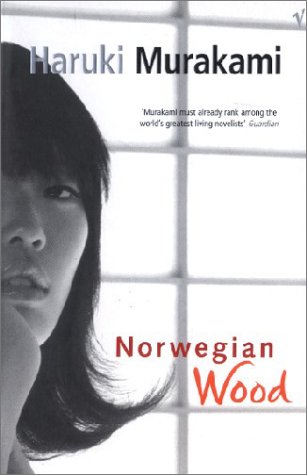
Norwegian Wood, Chapters 10-11
Just a little note: I'm having my wisdom teeth taken out today, and since I don't really know how I'm going to feel afterwards I'm not sure how good at commenting and arguing in favour of Norwegian Wood I'm going to be. Most likely I'll just be grumpy and in pain, but if I'm all asleep and stuff then I'll get round to saying things soon. You probably didn't need this explanation, but I like commenting!!)
Well... These last two chapters of Norwegian Wood brought both fully expected (Naoko's suicide) and utterly WTF (Reiko and Toru sexing!) moments that we will deal with properly and sensibly and nobody will say 'what the HELL was that with the sexy sex?!' Because I know what it was, and I'll explain it to you in a bit! And then, oh, Midori! Murakami got all romantic and stuff, and it was lovely.
Was anyone, in any way, surprised by Naoko's suicide? I think it was built up to well enough, not only in chapter 10 (she's gone to an actual mental hospital... she's not doing too well...) but, really, throughout the entire book. I think that we all knew it was going to happen, but Toru had somehow convinced himself that it wasn't, and so when it did, it was a huge shock for him. Such a huge shock that he had to go and be a bum because he couldn't face the realities of everyday life anymore (not that he was doing so great with them before). I just have to question whether or not he really loved her though- did he love her as a person, or did he just feel the need to protect her, and to try and save her from the fate that took Kizuki away from them? Did he just love her because he didn't know if he could deal with another loss of that magnitude, or did he really just love her? (You don't have to answer these... but if you have any answers, then great!)
Naoko's death left Toru in such a messed up position though, mainly because of the nature of his relationship with Midori. Because, let's face it, they love each other, and somehow complement each other, and I can't even tell you how happy I was when they declared their love for each other, because I really think that Midori was what Toru needed to lead him back to life, or at least to living in a way that was somewhat bearable. But, of course, this is all complicated by Naoko, because even though he doesn't really love her (or at least I think so), he is somehow entangled in her life, and doesn't quite know how to free himself from that kind of obligation to her. Her death should really solve this, only it doesn't and he actually goes the other way- feeling guilty that he loves Midori, and thinking that was a factor in her death (God, that boy's self-centred...). So, they're in a bit of a pickle. But can I just...
Anyway, in order to get Midori, Toru has to do something about all his feelings about and for Naoko. And, and here's where we get to perhaps the single weirdest moment in the book, the way he does this is through having a good time with Reiko. I'm not going to lie- when I first read this bit, I was literally like 'WHAT?!?!' and, actually, I was kind of annoyed. I mean, did all the women have to want to have sex with Toru? Are there no other men in Japan?! But, I thought about it a little (using all my English degree skills) and I kind of thought that their sexing was a kind of an end to his relationship with Naoko, and the beginning of a hopeful future with Midori. Because Reiko was so close to Naoko, together they were able to put her to rest, and effectively made a bridge between Naoko and Midori. What I mean is, if Midori had been the first person Toru had sex with after Naoko's death, then his entire relationship with her would have been marred by the shadow of Naoko. Because he instead had sex with Reiko, which was all about Naoko, he was able to put her to rest and can hopefully start afresh with Midori. OR, it was just weird. I have to tell myself that the former is true, just so I can consolidate that event into my whole experience of the book.
So... there's probably loads I've missed out, but I can't remember many more things because I read the last two chapters in a rush in a super long bath (that really wasn't meant to be that long) because I wanted to find out what happened! I enjoyed Midori's screening of and anger with Toru, and I was concerned at Toru's catatonic state because of bloody Naoko (RIP). One of the most interesting things for me was how Toru gained a greater insight into his actions, and how he actually stepped outside of his head for a minute to think about how his actions might affect others:
So, you could say I liked Norwegian Wood an awful lot. No, it wasn't a happy book, and it never made me laugh (don't be silly!) but it had an awful lot of soul, some really fabulous writing (you don't even want to know how much I've copied out of it) and some truly memorable characters. I think it ends with a great deal of hope, hope that Toru can start to really live, hope that he'll be such a good husband for Midori, hope that Reiko can live the rest of her life with as much sanity as anyone can in this crazy crazy world. Those who haven't been able to deal with life have departed it, and those who are left have to figure out how to carry on the best they can. It's an incredibly human book, and deals with the darkest side of humanity, something that we don't necessarily want to think about, but which, whether or not we do, still happens. I am a little bit in love with Murakami now, and want to read all of his books ever! And maybe I just will.
Well... These last two chapters of Norwegian Wood brought both fully expected (Naoko's suicide) and utterly WTF (Reiko and Toru sexing!) moments that we will deal with properly and sensibly and nobody will say 'what the HELL was that with the sexy sex?!' Because I know what it was, and I'll explain it to you in a bit! And then, oh, Midori! Murakami got all romantic and stuff, and it was lovely.
Was anyone, in any way, surprised by Naoko's suicide? I think it was built up to well enough, not only in chapter 10 (she's gone to an actual mental hospital... she's not doing too well...) but, really, throughout the entire book. I think that we all knew it was going to happen, but Toru had somehow convinced himself that it wasn't, and so when it did, it was a huge shock for him. Such a huge shock that he had to go and be a bum because he couldn't face the realities of everyday life anymore (not that he was doing so great with them before). I just have to question whether or not he really loved her though- did he love her as a person, or did he just feel the need to protect her, and to try and save her from the fate that took Kizuki away from them? Did he just love her because he didn't know if he could deal with another loss of that magnitude, or did he really just love her? (You don't have to answer these... but if you have any answers, then great!)
Naoko's death left Toru in such a messed up position though, mainly because of the nature of his relationship with Midori. Because, let's face it, they love each other, and somehow complement each other, and I can't even tell you how happy I was when they declared their love for each other, because I really think that Midori was what Toru needed to lead him back to life, or at least to living in a way that was somewhat bearable. But, of course, this is all complicated by Naoko, because even though he doesn't really love her (or at least I think so), he is somehow entangled in her life, and doesn't quite know how to free himself from that kind of obligation to her. Her death should really solve this, only it doesn't and he actually goes the other way- feeling guilty that he loves Midori, and thinking that was a factor in her death (God, that boy's self-centred...). So, they're in a bit of a pickle. But can I just...
"There is a decisive finality to what exists between Midori and me. It has an irresistible power that is bound to sweep me into the future... What I feel for Midori is a wholly different emotion. It stands and walks on its own, living and breathing and throbbing and shaking me to the roots of my being."Siiiiigh! I think "I am Heathcliff" from Wuthering Heights just got some competition for a description of love. And I can already predict that some of you are going to be like 'oh, Toru's not good enough for her', and he kind of isn't; except that the way he acts towards her pretty much fits her definition of love, and, well, she's getting everything she wants, and he's getting the most amazing character in the book. Fair enough deal, I'd say!
Anyway, in order to get Midori, Toru has to do something about all his feelings about and for Naoko. And, and here's where we get to perhaps the single weirdest moment in the book, the way he does this is through having a good time with Reiko. I'm not going to lie- when I first read this bit, I was literally like 'WHAT?!?!' and, actually, I was kind of annoyed. I mean, did all the women have to want to have sex with Toru? Are there no other men in Japan?! But, I thought about it a little (using all my English degree skills) and I kind of thought that their sexing was a kind of an end to his relationship with Naoko, and the beginning of a hopeful future with Midori. Because Reiko was so close to Naoko, together they were able to put her to rest, and effectively made a bridge between Naoko and Midori. What I mean is, if Midori had been the first person Toru had sex with after Naoko's death, then his entire relationship with her would have been marred by the shadow of Naoko. Because he instead had sex with Reiko, which was all about Naoko, he was able to put her to rest and can hopefully start afresh with Midori. OR, it was just weird. I have to tell myself that the former is true, just so I can consolidate that event into my whole experience of the book.
So... there's probably loads I've missed out, but I can't remember many more things because I read the last two chapters in a rush in a super long bath (that really wasn't meant to be that long) because I wanted to find out what happened! I enjoyed Midori's screening of and anger with Toru, and I was concerned at Toru's catatonic state because of bloody Naoko (RIP). One of the most interesting things for me was how Toru gained a greater insight into his actions, and how he actually stepped outside of his head for a minute to think about how his actions might affect others:
"Whenever I get involved in something, I shut out everything else. But then I began to think about how I would feel and the tables had been turned and Midori had moved somewhere without telling me where or getting in touch with me for three weeks. I would have been hurt- hurt badly, no doubt... What a terrible thing it is to wound someone you really care for- and to do it so unconsciously."And I slow-clapped him for not being a psychopath (psychological rather than murdery). And, of course, Reiko brought all her wisdom with her:
"'I mean, that was such a sad little funeral! No one should have to die like that.'Death is death is death, and they're still alive; and even if sometimes that's all they've got to hold onto, it's still a lot.
Reiko stretched out her hand and stroked my head. 'We all have to die like that sometime. I will, and so will you.'"
So, you could say I liked Norwegian Wood an awful lot. No, it wasn't a happy book, and it never made me laugh (don't be silly!) but it had an awful lot of soul, some really fabulous writing (you don't even want to know how much I've copied out of it) and some truly memorable characters. I think it ends with a great deal of hope, hope that Toru can start to really live, hope that he'll be such a good husband for Midori, hope that Reiko can live the rest of her life with as much sanity as anyone can in this crazy crazy world. Those who haven't been able to deal with life have departed it, and those who are left have to figure out how to carry on the best they can. It's an incredibly human book, and deals with the darkest side of humanity, something that we don't necessarily want to think about, but which, whether or not we do, still happens. I am a little bit in love with Murakami now, and want to read all of his books ever! And maybe I just will.
Top Ten Tuesday
Well hey there, gals and guys, and welcome to this weeks instalment of Top Ten Tuesday. And, oh my, it's the last one of January, and oh dear god, where did that month go?! I'm going to be having my wisdom teeth taken out today, maybe even as you read this, so please leave me lots of lovely comments to wake up to (in horrible pain!) A quick note on today's picks- my book club would obviously consist of supersmart people who were preferably also English graduates (well, they don't even have to be graduates, just, you know, people with some knowledge of how to analyse a book properly) because a LOT of these books I wouldn't necessarily recommend to people who don't read much, I just desperately want to discuss them!
So, anyway, with that massive preamble, here are:
Top 10 Books I Think Would Make Great Book Club Picks
1. Great House by Nicole Krauss- I've chosen this basically because I finished it more than a week ago, and I still can't think of what to say about it. It's just so... sort of intertwined stories, but not too intertwined, but then I think you can make other connections too, and basically I need to discuss this with people to figure out what it was really about! All I know is that I loved it, which does not a review make!
2. How To Be A Woman by Caitlin Moran- Basically because every person ever should read this. But also because there are all sorts of funny things we could all talk about, and then also we could discuss feminism, which is always awesome (unless you're one of those "I'm not a feminist, but..." people, in which case you can't come to my book group!)
3. Blonde by Joyce Carol Oates- Can't we all appreciate a good fictional biography of Marilyn Monroe? Lots to discuss in this one too- not only about the story itself, but also the ethics of writing such a book, and how seriously we can take it, and all other good things like that.
4. The Grapes of Wrath by John Steinbeck- Oh dear god, the things that can be discussed in this book! I studied this book in Uni, and the one hour seminar was really not enough time to discuss all of the themes and the scale and the pure magnificence of this book.
5. Anything by Jane Austen- There is any number of things that one could discuss about any of the six Jane Austen novels, and I want to talk about all the things with many other Jane Austen fan people. It'd be like that book, The Jane Austen Book Club, only not shit.
6. The Handmaid's Tale by Margaret Atwood- Another feministy discussiony book, but also one that I think people would really really enjoy, just for all the righteous anger and stuff it brought up, at least in me! Then we could have a revolution and take over the world...
7. It by Stephen King- This is, in fact, the next Stephen King book I'm reading (it's also my favourite!) but aside from both those things, there's so much that can be discussed about it. Like, so much that I'm sort of dreading reviewing it because it's going to be like a ten page long ramble about all its fabulousness that literally nobody will read past, say, the first two paragraphs. BUT THERE'S SO MUCH TO SAY! This is why I need a book club.
8. Wuthering Heights by Emily Bronte- Much as I hate hearing people talk about how much they hate this book (and I can't think of anyone I know who doesn't) I feel like a book club would be a perfect forum for me to convince everyone about why it's wonderful. And it's not its narrative structure, let me tell you that!
9. Extremely Loud and Incredibly Close by Jonathan Safran Foer- This is almost the opposite of Wuthering Heights- I was massively ambivalent about this book (well, about the story, I was pretty freaking excited by the actual writing) but I feel that, if convinced by the right people, I could be convinced of its innate brilliance. Maybe.
10. No Logo by Naomi Klein- I should have really put The Shock Doctrine because, despite starting it in September, I've been too scared to pick it up again, and a book club would force me to read it! But anyway, No Logo is something I'm fairly convinced everyone should read, and then we could all have an anti-capitalist revolution along with our feminist one. The world's going to be SO GOOD after all our reading!
These aren't necessarily my top book club picks, but they're the best ones I could think of on the spur of the moment! Now I just need to find some like-minded people to read/start a revolution with. Or... maybe I could just keep doing readalongs here! (If anyone knows of a Grapes of Wrath readalong anywhere, please point me in that direction and I'll be on it! OR, if you'd be interested in reading it along with me, I could probably be convinced to host it...)
So, anyway, with that massive preamble, here are:
Top 10 Books I Think Would Make Great Book Club Picks
1. Great House by Nicole Krauss- I've chosen this basically because I finished it more than a week ago, and I still can't think of what to say about it. It's just so... sort of intertwined stories, but not too intertwined, but then I think you can make other connections too, and basically I need to discuss this with people to figure out what it was really about! All I know is that I loved it, which does not a review make!
2. How To Be A Woman by Caitlin Moran- Basically because every person ever should read this. But also because there are all sorts of funny things we could all talk about, and then also we could discuss feminism, which is always awesome (unless you're one of those "I'm not a feminist, but..." people, in which case you can't come to my book group!)
3. Blonde by Joyce Carol Oates- Can't we all appreciate a good fictional biography of Marilyn Monroe? Lots to discuss in this one too- not only about the story itself, but also the ethics of writing such a book, and how seriously we can take it, and all other good things like that.
4. The Grapes of Wrath by John Steinbeck- Oh dear god, the things that can be discussed in this book! I studied this book in Uni, and the one hour seminar was really not enough time to discuss all of the themes and the scale and the pure magnificence of this book.
5. Anything by Jane Austen- There is any number of things that one could discuss about any of the six Jane Austen novels, and I want to talk about all the things with many other Jane Austen fan people. It'd be like that book, The Jane Austen Book Club, only not shit.
6. The Handmaid's Tale by Margaret Atwood- Another feministy discussiony book, but also one that I think people would really really enjoy, just for all the righteous anger and stuff it brought up, at least in me! Then we could have a revolution and take over the world...
7. It by Stephen King- This is, in fact, the next Stephen King book I'm reading (it's also my favourite!) but aside from both those things, there's so much that can be discussed about it. Like, so much that I'm sort of dreading reviewing it because it's going to be like a ten page long ramble about all its fabulousness that literally nobody will read past, say, the first two paragraphs. BUT THERE'S SO MUCH TO SAY! This is why I need a book club.
8. Wuthering Heights by Emily Bronte- Much as I hate hearing people talk about how much they hate this book (and I can't think of anyone I know who doesn't) I feel like a book club would be a perfect forum for me to convince everyone about why it's wonderful. And it's not its narrative structure, let me tell you that!
9. Extremely Loud and Incredibly Close by Jonathan Safran Foer- This is almost the opposite of Wuthering Heights- I was massively ambivalent about this book (well, about the story, I was pretty freaking excited by the actual writing) but I feel that, if convinced by the right people, I could be convinced of its innate brilliance. Maybe.
10. No Logo by Naomi Klein- I should have really put The Shock Doctrine because, despite starting it in September, I've been too scared to pick it up again, and a book club would force me to read it! But anyway, No Logo is something I'm fairly convinced everyone should read, and then we could all have an anti-capitalist revolution along with our feminist one. The world's going to be SO GOOD after all our reading!
These aren't necessarily my top book club picks, but they're the best ones I could think of on the spur of the moment! Now I just need to find some like-minded people to read/start a revolution with. Or... maybe I could just keep doing readalongs here! (If anyone knows of a Grapes of Wrath readalong anywhere, please point me in that direction and I'll be on it! OR, if you'd be interested in reading it along with me, I could probably be convinced to host it...)
Subscribe to:
Posts (Atom)