A fun fact about A Clergyman's Daughter- before I read it, both times, I thought it was about a girl who got hooked on drugs and had to work her way out of that whole situation. I had absolutely no basis for that thought, and it's wrong anyway, so who knows what I was thinking! Twice! Anyway, what I got instead was a book absolutely inseparable from Orwell's social and political views, but that still managed to contain a story that was absolutely compelling, and really interesting, as well as managing to be a springboard for Orwell's political agenda.
A Clergyman's Daughter is the story of Dorothy, a clergyman's daughter (see what he did there?!) who, in the first section, is exhaustingly pious, and lives the way she thinks she should be, according to God's law, her father's wishes, and for the good of all the parishioners. Naturally, she barely spares a thought for herself, and any uncharitable thoughts she has require punishment from a long pin she keeps on her at all times. It's a very self-flagellating existence, and one that is fuelled by continually fighting against herself- if there is something she doesn't want to do, that's the best reason there is for doing it. It's very tiring and concerning to read, but fortunately it only lasts for the first section- because after that she gets amnesia, wakes up in London and has no idea what to do because she has no idea what she used to do.
Sadly I'm not kidding about the amnesia which is the one weak spot in the novel, I'd say- we know that she disappeared for about 9 days, but we have no idea what happened in those 9 days, which is kind of disappointing. More fun is the fact that everyone in the village assumes that Dorothy has eloped with this 'naughty' man, and she obviously can't do anything to stop this. It's really really frustrating not knowing how or why she did leave, but I reckon it's got something to do with her subconscious trying to escape from all those self-inflicted pinpricks... The only other thing that really bugged me about the book is this one chapter that's in the form of a play- not that I think it was inappropriate for the circumstances it describes, but just because I don't like mixtures of forms- one or the other, that's what I say! (Yeah, I don't really know why this annoys me, but it really does- although I do like reading plays almost as much as prose, so I'm clearly just nuts).
Anyway, apart from these two teeny things, I really did like basically all the rest of the book. There was a clear relation to Down and Out in Paris and London, in that Orwell used what he learned whilst living in poverty, and applied it to the novel form, I think with great success, considering that it doesn't at all seem like he's preaching, but you get a pretty clear picture of what living in poverty would be like for a woman in the 1930s (since she's a woman, she of course ends up in a brothel at one point-only she doesn't know it's a brothel which is a bit embarrassing for those of us reading...) The other book I was reminded of whilst reading was The Grapes of Wrath, which was actually written 4 years after this, because it goes into the crushing cycle of poverty, how you work and work (picking hops, which reminded me greatly of the Joads working in California picking peaches) and yet only have enough money to live on, and so it continues. I also thought it was interesting that, while Dorothy has amnesia she is fine with living in poverty, but as soon as she remembers what she used to have, she finds it much harder to deal with. I just found this interesting as a concept, and as a sort of 'which is worse' proposition- to be poor your whole life and never know anything different, or to have had some kind of comfort and then have it taken away, and have to live in poverty? I wouldn't really like to choose between the two, but I still thought it was an interesting point.
Aside from the poverty thing, Orwell also manages to work into the narrative a criticism of independent private schools (or public schools, I don't know, I get confused) which I actually found really informative, albeit a little bit of a curveball compared to the rest of the novel. What he basically calls for, though, is a full regulation of all schools by the government, as well as the crazy notion that maybe teachers sometimes know better than parents about what their children should be learning, especially when said parents have no education themselves. Different as it may be from the rest of the novel, this was possibly my favourite section, since it made me consider how good modern education is now (although it could obviously be better funded), and it also meant I could get pissed off at ignorant people, which, whilst infuriating, is also sort of fun. The book was kind of worth it for me just for that alone!
Having said all that, you probably shouldn't listen to me at all, because Orwell himself referred to this book as "tripe", according to wikipedia, and his opinion matters the most, right? I think though, as Orwell's only book featuring a lead female protagonist, and a pretty strong and admirable one at that, this is definitely a book worth taking a look at.
Friday, 7 October 2011
Thursday, 6 October 2011
Literary Blog Hop, October 6-9
Yay to hop amongst blogs and also to be literary and stuff. Note my eloquence and things, which I'll try to improve when I'm actually answering the question and trying not to be a moron. Both of which are going to be very difficult for me...
Sorry, please ignore that little brain fart. This month's question (moving swiftly along, which I think is for the best) is: If you could invite any three literary figures from different eras to a Sunday Dinner, who would they be and why?
Come on, how great is this question?! I'm struggling, I'll admit, to just think of three, because there are so many people that I think you could have great conversation with, and the question really is, what sort of conversation do you want? I mean, do you invite Plato, Socrates and Aristotle and get them to discuss the meaning of life (and, let's face it, so much more), or do you invite say Byron, Shelley and Shakespeare, and get them to write you poetry and to just generally sit around being awesome? On the whole, though, I think that I'd probably most like to discuss feminist thought at my Sunday Dinner, so I think I'd probably have to invite Margaret Atwood, Charlotte Bronte and Virginia Woolf (are they from different enough eras? I think so...) I think Margaret and I could educate Charlotte a little about modern feminism, but she could probably teach us a few things too, and Virginia Woolf could just sit around being all kinds of awesome, while we also tell her why she shouldn't kill herself. This decision of mine is dictated entirely by the kind of conversation I'd like to have, and an alternative Dinner would include Oscar Wilde (so so wonderfully witty), John Steinbeck (because he's so intense and amazing) and probably Stephen King, because those three just fit so well together! I'm thinking of keeping them as my alternates, along with Maya Angelou, in case any of the other three can't make it. We'll see.
How about you? Do you have an actual definitive list of three, or do you simply have to mention about 50 different literary figures that you would invite (I have, in fact forgotten Harper Lee and George Orwell, so let's make that 52)? And most importantly, did you find this question as exciting as I did?!
Wednesday, 5 October 2011
Orwell October: Down and Out In Paris and London
Can we also talk about how much I love this cover? Like, enough to buy this one, even though I already had a copy. Yeah.
I've read Down and Out in Paris and London once before, and while I was re-reading it, I realised that all I know about poverty, I learned from this book (and, considering it's nearly 80 years old, that's probably not a good thing). I kind of feel like I should object to the book on principle though, because Orwell went to Eton, was, I think, pretty well off, and I'm guessing had a pretty good safety net in terms of being able to pull himself back out of poverty even once he'd sunk into it. However- I can't fault him, even for his middle-classness, because he makes it clear himself that yes, he is really lucky that he was able to escape poverty, and that this book is sort of his attempt to make other people aware of the poverty that existed, and maybe even to get them to do something about it (certainly he makes suggestions as to how he thinks the poverty found in London should be eradicated).
So yeah, once I got over my whole 'well, he went to Eton so I'm sure he was fine,' prejudice, I've gotta say, this book was pretty great. I think I've made it clear that I really really like the way Orwell writes, so he could probably be writing about something really dull like the economy (I don't find the economy dull in itself, but I literally am physically unable to understand financial jargon, so I feel like a moron whenever I try to read something about it) and I'd be like 'Wow! He so knows everything that's happening and stuff!' But really, everything I know about poverty in London in the 1930s, I first learnt from this book- there's a bit where he talks about this really unpleasant lodging where you sleep sitting up, leaning against this bit of string, and then when it's morning, the string is cut and everyone has to leave. It sounds wholly unpleasant, but when I re-encountered it in this reading I was like 'Ah, where have I heard about this before', and as far as I can tell, it was from this book. Good times!
Poverty, I imagine is pretty awful, and while it's reductive to compare poverty now to poverty in the 1930s (which, I only just realised the prevalence of which was probably mainly to do with the Wall Street Crash and all that jazz- History GCSE was wasted on me) but this book makes poverty then seem pretty awful. I mean, having basically a penny a day for food, subsisting on bread and tea (and, kind of hilariously, cigarettes, which to Orwell seem more important than food) and because of the lack of food the lack of energy to find a job, and so the cycle continues. If I'm pushed to say where poverty seemed more awful, I'd have to go with London- in Paris, Orwell at least finds what sounds like one of the hardest, least rewarding jobs in the world, but it is, at least, a job. In London, there don't seem to be any prospects, and nothing a person can do to pull themselves out of poverty and back into jobs. If I was going to hazard a guess, I'd say they had a Conservative Government, because, seriously, that sounds really familiar...
Orwell encounters some extremely interesting people in his journey through poverty, and in doing so manages to not romanticise the conditions that they exist in, which I think he could easily have done, whilst still pointing out that basically, you can still be a wholly interesting and worthwhile person, even if you have fallen upon hard times. My favourite of all these people was Bozo, a street artist who believes, quite rightly, that it is who you are, rather than what you have that makes you either worth knowing or not so much. This leads to this exchange between the two men:
" 'It seems to me that when you take a man's money away, he's fit for nothing from that moment'Such a philosophy in such abject conditions is wonderful to hear, and Orwell quite rightly admires Bozo, and seems to hold him up as an example to everyone. Or maybe that's just me.
'No, not necessarily. If you set yourself to it, you can still live the same life, rich or poor. You can still keep on with your books and your ideas. You just got to say to yourself "I'm a free man in here" '- he tapped his forehead- 'and you're all right.' "
Down and Out in Paris and London is not only well-written (because, why would you expect anything else?) it's also a really interesting slice of social history, and I think really we've all got to be grateful that Orwell did have these weeks of poverty in his life, because who else could have recorded it so vividly and with such style? I found the end, where Orwell states all the important lessons he has learned, so that others might learn them also, really heartwarming, and it is clear how strongly he wants others to also heed these lessons so that they might do something about the conditions faced by many people in Britain. You never doubt that Orwell cares about these people, and for that I can't help but adore him, and this book.
Tuesday, 4 October 2011
Top Ten Tuesday
So this week's top ten is about endings that left me with my mouth hanging open. Instead of ten, though, I'm just going to talk about two, because, really, they deserve longer consideration than just the teeny description I usually give things in these lists. As for spoilers... I'm going to do my best, but I can't promise you won't get some kind of idea about how shit goes down, but I won't give anything really vital away, and even if I did, it'd probably be different than what you thought it was anyway, because that's what always happens to me when someone describes something to me.
Any, the first ending that left me gobsmacked was the end of The Sopranos, which I only finished watching this year because, you know, I'm completely behind the times. Now, I'm assuming that we all know that it kind of cuts out in the middle of a scene, which caused a big stir when it was first broadcast and made people call up HBO and find out what the hell had gone wrong. This I knew before I watched it, but I didn't realise just how tense the last scene actually is. It's probably one of the most tense things I've ever seen, where you're constantly expecting something to happen- I swear my heart was thumping in anticipation while I was watching, while simultaneously being positive that this wasn't the final scene that cuts out in the middle that I knew about and then... it totally was. I was pissed off and shocked and I'm pretty sure my mouth just fell open by its own will, and it was awful and amazing and probably the perfect way to end that particular series.
The other one that immediately occurred to me when I first saw this topic was the conclusion of The Dark Tower Series by Stephen King (note how the end of whole series are more shocking than that of single books- the emotional build-up of the preceding 6 books, or 85 episodes meaning that whatever happens, it's probably going to be shocking to some extent). I mean, I don't know if you've read all seven books, or none, or maybe just a few of them (I obviously think that you should, like, immediately) but trust me- King creates a whole load of characters that you love, gives you a really strong attachment to them, makes you go to hell and back with them, and the endings (there are sort of three) are kind of a relief, and yet, one of them is such a headfuck that you just really don't know what to do with yourself! The ending I'm thinking of (and hopefully some of you will have read it, and so know what on earth I'm talking about) I actually thought was more of an afterword than anything, but actually, I quickly realised it was still part of the story, and I was excited because, you know, yay, there was more, but actually it was the most frustrating thing ever, but also kind of an amazing way to end the series. At least, I thought it was...
So yeah, these are the two most shocking, and irritating/fabulous endings of books I can think of. I'm sure everyone will have come up with more, and really good ones too, but these are the only two I can really remember having such an impact on me. They are, for that reason, pretty great, and really worth watching/reading. So go and do it!
Any, the first ending that left me gobsmacked was the end of The Sopranos, which I only finished watching this year because, you know, I'm completely behind the times. Now, I'm assuming that we all know that it kind of cuts out in the middle of a scene, which caused a big stir when it was first broadcast and made people call up HBO and find out what the hell had gone wrong. This I knew before I watched it, but I didn't realise just how tense the last scene actually is. It's probably one of the most tense things I've ever seen, where you're constantly expecting something to happen- I swear my heart was thumping in anticipation while I was watching, while simultaneously being positive that this wasn't the final scene that cuts out in the middle that I knew about and then... it totally was. I was pissed off and shocked and I'm pretty sure my mouth just fell open by its own will, and it was awful and amazing and probably the perfect way to end that particular series.
The other one that immediately occurred to me when I first saw this topic was the conclusion of The Dark Tower Series by Stephen King (note how the end of whole series are more shocking than that of single books- the emotional build-up of the preceding 6 books, or 85 episodes meaning that whatever happens, it's probably going to be shocking to some extent). I mean, I don't know if you've read all seven books, or none, or maybe just a few of them (I obviously think that you should, like, immediately) but trust me- King creates a whole load of characters that you love, gives you a really strong attachment to them, makes you go to hell and back with them, and the endings (there are sort of three) are kind of a relief, and yet, one of them is such a headfuck that you just really don't know what to do with yourself! The ending I'm thinking of (and hopefully some of you will have read it, and so know what on earth I'm talking about) I actually thought was more of an afterword than anything, but actually, I quickly realised it was still part of the story, and I was excited because, you know, yay, there was more, but actually it was the most frustrating thing ever, but also kind of an amazing way to end the series. At least, I thought it was...
So yeah, these are the two most shocking, and irritating/fabulous endings of books I can think of. I'm sure everyone will have come up with more, and really good ones too, but these are the only two I can really remember having such an impact on me. They are, for that reason, pretty great, and really worth watching/reading. So go and do it!
Monday, 3 October 2011
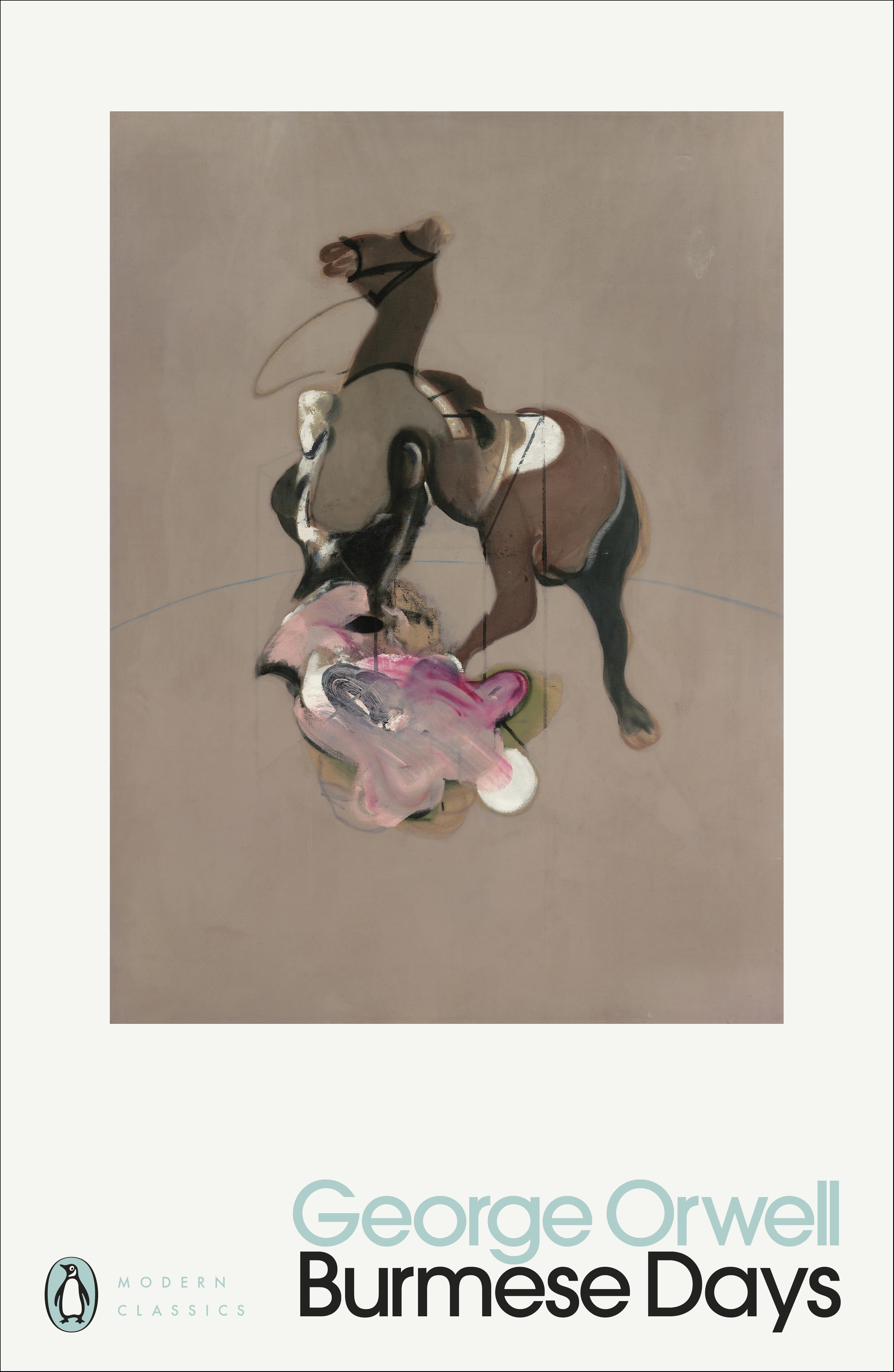
Orwell October: Burmese Days
Kicking off Orwell October with Burmese Days, I was a little nervous. Since I've only read Animal Farm and 1984 by Orwell previously, I sort of thought 'Well, what if I don't like any of the rest of his books? What if I struggle through them and DIE and have to not do Orwell October after all, and then everyone (i.e. my legions of followers) will be really disappointed and I'll look like a knob!' Yes, I am crazy, is this your first time here? Anyway, I needn't have worried, because Burmese Days was really enjoyable, and even though hardly any of the events in it went the way I wanted them to, they went exactly the way they were supposed to, and probably relatively accurately to how they would have happened if they had occurred in real life. Although that doesn't mean I have to like them...
Burmese Days is set in the Good Old Days of the British Empire, when Britannia really did rule the waves, and oppression of native people was ok because it was for their own good, and anyway, they're just savages so they won't know if it's not. Our hero, Mr Flory, is a British man who doesn't exactly think like the rest of the white men in Burma- his best friend is an Indian doctor (I don't really know what he's doing in Burma, but then what were the British doing there, you might also ask- in other words, it's not really that important), and while I find him lacking in certain ways, there is no doubt that he is still the character in the book that a person living in these times who opposes oppression of any kind can most identify with- while he fails, at times, to do what his conscience tells him, he is still better than, say, Ellis, another white man who insists on using the N-word to describe the Burmese people, and is pretty much unspeakably awful, and is rightly presented that way. Through these, and a whole host of other characters, Orwell really manages to capture life as it would have been at the time, and, I think, creates a relatively accurate insight into the benefits and disadvantages of colonial living.
Thinking back on the book now, it seems to me that not a lot really happens- there is a rogue native who plots against Flory's doctor friend for the bizarre reason of wanting to be part of their white men's club (although why anyone would want to hang around with those horrible racist bores is beyond me, and I suspect Flory), Flory falls in love, tries to show his lady friend why he loves Burma, unknowing that he has, in fact, set his attentions on basically one of the men from the Club, only with a vagina. This lack of events, though, somehow doesn't seem to matter while you're reading it, because you are so well transported to Burma- you can almost smell the bazaars, and you're almost sitting in the Club with the white folk, sweating your butt off because the guy pulling the fan has fallen asleep in the sun outside. The sleepy lifestyle these men lead is almost transferred to you as you read, and you're lulled into belonging to their world, as easily as in any other book I've read. From what I've seen, Orwell's writing is peculiarly well-suited to inducing such an effect, and it's always a pleasure to enter into the worlds he creates.
The most irritating part of the book was, I felt, the relationship between Elizabeth and Flory. Not irritating in a bad way, because it was not believable or badly written, but just frustrating because she was so not good enough for him, even though he believes she is too good. Flory is basically prime for a romance in the novel, considering that he has become so frustrated with the way they live in Burma "Oh what a place, what people! What a civilisation is this of ours- this Godless civilisation founded on whisky, Blackwoods and the 'Bonzo' pictures! God have mercy on all of us, for all of us are part of it." and when Elizabeth arrives he is instantly smitten. But here's the thing. Elizabeth is a bitch. She's an upper-class, over-entitled hag, who thinks that only one kind of life (the high life) is suitable to live, and everything else is just 'beastly'. I hate her. I hate her more than I've hated a book character for a while, and here's the thing- I don't even think I'm supposed to hate her. Well- I think there is a certain extent to which we are supposed to dislike her, because she is continually rude to all the natives and there's a whole chapter in which Orwell makes it clear that she is a bit of a twat, but other than that, I think we're supposed to see it as normal that Flory wants to marry her because he's a man, and she's an unmarried woman, and it's just the thing that should happen. Here's where a little bit of respect is lost for Flory- there are plenty of eligible Burmese women who he could marry (he even has a mistress who turns into a little bit of a pain once Elizabeth shows up) but this is not even a consideration because it is quite clearly ingrained into him that he must marry a white woman, or no woman at all. I don't know if this is just because it's something that Orwell didn't really consider to be suitable, or because he wanted to develop the relationship between Elizabeth and Flory so that it gets to the climax that it does, but it's still a little bit of a sticking point for me that I can't really see what Flory does in Elizabeth.
Or maybe I can. It is made clear that Flory is extremely lonely in his life, and indeed he even says that "Beauty is meaningless until it is shared" a line that I think is one of the best, and truest in the novel. The implication is, I feel, that while Flory more or less enjoys his life in Burma, he is held back from really appreciating his surroundings by having no one he can really talk to and admire nature with. He more or less hates the man at the club, his servants are sycophantic so he can't really talk to them, and besides they, along with the Doctor, are still natives, and so, it seems, he can't really share all his thoughts and feelings with them. What he really needs is a wife, and, unable to face the indignity of marrying a native woman, he latches onto the first eligible white woman to be seen around the parts for a long while, projecting onto her his own feelings, and believing he can make her see Burma as he does, something which, as the reader can see, is pretty much never going to happen. But still, it seems, he must persist- must try to get at least something he wants, before everything is lost to him. It's kind of tragic in a way, and yet kind of annoying in another- surely he'd rather be alone than be with such an annoyingly judgemental Elizabeth? Although, as it is made clear a few times, Elizabeth is very beautiful- so that's obviously all that matters in the end, I suppose- how women's inner lives seem so much less important than those of men's, at least in fiction...
Sorry, didn't mean to get all feminist on you then! I really did enjoy Burmese Days, and, to be honest, Elizabeth is a much better drawn out woman than many in even today's fiction, and even if she wasn't, this would still be worth reading as a portrait of a man's unconventional views about being part of the establishment of the British Empire. I'd recommend this as, maybe not the first Orwell book you should read, but definitely one that you should check out at some point, especially if you're a fan of his writing. Even in this, his first novel, it is quite clear that he could only have been a writer- oh yes, that's how good.
Next up, I'm going to be reading Down and Out in Paris and London, which I've read before but don't really remember. I'm hoping, however, that it'll teach me how to live like a tramp, something which I may need in the near future if the whole unemployment thing doesn't start looking up...
Burmese Days is set in the Good Old Days of the British Empire, when Britannia really did rule the waves, and oppression of native people was ok because it was for their own good, and anyway, they're just savages so they won't know if it's not. Our hero, Mr Flory, is a British man who doesn't exactly think like the rest of the white men in Burma- his best friend is an Indian doctor (I don't really know what he's doing in Burma, but then what were the British doing there, you might also ask- in other words, it's not really that important), and while I find him lacking in certain ways, there is no doubt that he is still the character in the book that a person living in these times who opposes oppression of any kind can most identify with- while he fails, at times, to do what his conscience tells him, he is still better than, say, Ellis, another white man who insists on using the N-word to describe the Burmese people, and is pretty much unspeakably awful, and is rightly presented that way. Through these, and a whole host of other characters, Orwell really manages to capture life as it would have been at the time, and, I think, creates a relatively accurate insight into the benefits and disadvantages of colonial living.
Thinking back on the book now, it seems to me that not a lot really happens- there is a rogue native who plots against Flory's doctor friend for the bizarre reason of wanting to be part of their white men's club (although why anyone would want to hang around with those horrible racist bores is beyond me, and I suspect Flory), Flory falls in love, tries to show his lady friend why he loves Burma, unknowing that he has, in fact, set his attentions on basically one of the men from the Club, only with a vagina. This lack of events, though, somehow doesn't seem to matter while you're reading it, because you are so well transported to Burma- you can almost smell the bazaars, and you're almost sitting in the Club with the white folk, sweating your butt off because the guy pulling the fan has fallen asleep in the sun outside. The sleepy lifestyle these men lead is almost transferred to you as you read, and you're lulled into belonging to their world, as easily as in any other book I've read. From what I've seen, Orwell's writing is peculiarly well-suited to inducing such an effect, and it's always a pleasure to enter into the worlds he creates.
The most irritating part of the book was, I felt, the relationship between Elizabeth and Flory. Not irritating in a bad way, because it was not believable or badly written, but just frustrating because she was so not good enough for him, even though he believes she is too good. Flory is basically prime for a romance in the novel, considering that he has become so frustrated with the way they live in Burma "Oh what a place, what people! What a civilisation is this of ours- this Godless civilisation founded on whisky, Blackwoods and the 'Bonzo' pictures! God have mercy on all of us, for all of us are part of it." and when Elizabeth arrives he is instantly smitten. But here's the thing. Elizabeth is a bitch. She's an upper-class, over-entitled hag, who thinks that only one kind of life (the high life) is suitable to live, and everything else is just 'beastly'. I hate her. I hate her more than I've hated a book character for a while, and here's the thing- I don't even think I'm supposed to hate her. Well- I think there is a certain extent to which we are supposed to dislike her, because she is continually rude to all the natives and there's a whole chapter in which Orwell makes it clear that she is a bit of a twat, but other than that, I think we're supposed to see it as normal that Flory wants to marry her because he's a man, and she's an unmarried woman, and it's just the thing that should happen. Here's where a little bit of respect is lost for Flory- there are plenty of eligible Burmese women who he could marry (he even has a mistress who turns into a little bit of a pain once Elizabeth shows up) but this is not even a consideration because it is quite clearly ingrained into him that he must marry a white woman, or no woman at all. I don't know if this is just because it's something that Orwell didn't really consider to be suitable, or because he wanted to develop the relationship between Elizabeth and Flory so that it gets to the climax that it does, but it's still a little bit of a sticking point for me that I can't really see what Flory does in Elizabeth.
Or maybe I can. It is made clear that Flory is extremely lonely in his life, and indeed he even says that "Beauty is meaningless until it is shared" a line that I think is one of the best, and truest in the novel. The implication is, I feel, that while Flory more or less enjoys his life in Burma, he is held back from really appreciating his surroundings by having no one he can really talk to and admire nature with. He more or less hates the man at the club, his servants are sycophantic so he can't really talk to them, and besides they, along with the Doctor, are still natives, and so, it seems, he can't really share all his thoughts and feelings with them. What he really needs is a wife, and, unable to face the indignity of marrying a native woman, he latches onto the first eligible white woman to be seen around the parts for a long while, projecting onto her his own feelings, and believing he can make her see Burma as he does, something which, as the reader can see, is pretty much never going to happen. But still, it seems, he must persist- must try to get at least something he wants, before everything is lost to him. It's kind of tragic in a way, and yet kind of annoying in another- surely he'd rather be alone than be with such an annoyingly judgemental Elizabeth? Although, as it is made clear a few times, Elizabeth is very beautiful- so that's obviously all that matters in the end, I suppose- how women's inner lives seem so much less important than those of men's, at least in fiction...
Sorry, didn't mean to get all feminist on you then! I really did enjoy Burmese Days, and, to be honest, Elizabeth is a much better drawn out woman than many in even today's fiction, and even if she wasn't, this would still be worth reading as a portrait of a man's unconventional views about being part of the establishment of the British Empire. I'd recommend this as, maybe not the first Orwell book you should read, but definitely one that you should check out at some point, especially if you're a fan of his writing. Even in this, his first novel, it is quite clear that he could only have been a writer- oh yes, that's how good.
Next up, I'm going to be reading Down and Out in Paris and London, which I've read before but don't really remember. I'm hoping, however, that it'll teach me how to live like a tramp, something which I may need in the near future if the whole unemployment thing doesn't start looking up...
Sunday, 2 October 2011
Orwell October
Why do I keep talking about Orwell October (Ok, I've mentioned it about twice)? What is it? Why are you so excited by it? These are all valid questions, and don't worry, they're all going to be answered in good time. But let me ask you a question- How many George Orwell books have you read? Probably 1984, maybe Animal Farm, but as for the rest? Not so much.
Well, me too. I've read an extra novel and non-fiction work than those, but pretty much, I'm an uneducated Orwell fan. I also happen to adore his writing style, and I feel like, instead of just reading 1984 for, ooh, the 20th time, I've decided that this October is the time to read the rest (and revisit the ones I've already read). October, obviously because of the wonderful alliteration (you know you love it), although I have had mild moments of regret because, obviously, I could just spend the month reading scary stuff. But show me a book scarier than 1984, and you're a better person than me!
So, the Orwell books that I have (which is basically all of them) that I'll be reading this month are:
Fiction
Burmese Days
A Clergyman's Daughter
Keep the Aspidistra Flying
Coming up for Air
Animal Farm
1984
Non-Fiction
Down and Out in Paris and London
The Road to Wigan Pier
Homage to Catalonia
Essays
A Life in Letters
Of these, I'm saving A Life in Letters until last. This was a bit of a dilemma for me, because I wondered whether it was better to read it first or last, and I thought, well, I kind of hate it when you're reading a book and you're wondering if this or that bit relates to something that happened in the author's life. By leaving the letters until the end, I'll still undoubtedly be doing that, but at least it will be after the fact. And then it's more fun.
Just so we're all aware of the sacrifices I make just to bring you the best reviews of anything you've ever read (ahem), this is the copy that I'll be reading Orwell's novels from:
Since it's The Complete novels, and only has 800 and something pages, this is what the said pages actually look like:
Yikes, that's some tiny writing! The things I do for others- honestly, I think I might need my sainthood soon. Or maybe not...
Anyway, apart from the super-exciting Orwell madness going on this October, I will also be reading Frankenstein for the Classics Circuit, which is the first time I've participated in the blog tour, so I'm predictably excited about it; and I'm group reading Dracula with Allie (and probably some other people too!) over at A Literary Odyssey. AND I'm going to be giving stuff (ie books) I've got lying round my house away and taking part in my first proper readathon which I am the most excited about than possibly anything I've ever been excited about. Maybe. Basically, October's going to rock around these parts, so get excited everyone! And tell me to shut up if I tell you how I love Orwell too much...
P.S... I know I should technically have posted this yesterday, but it's my blog so I can do what I want. And besides, I had to tell everyone how much I disliked The Golden Notebook yesterday, didn't I?!
Well, me too. I've read an extra novel and non-fiction work than those, but pretty much, I'm an uneducated Orwell fan. I also happen to adore his writing style, and I feel like, instead of just reading 1984 for, ooh, the 20th time, I've decided that this October is the time to read the rest (and revisit the ones I've already read). October, obviously because of the wonderful alliteration (you know you love it), although I have had mild moments of regret because, obviously, I could just spend the month reading scary stuff. But show me a book scarier than 1984, and you're a better person than me!
So, the Orwell books that I have (which is basically all of them) that I'll be reading this month are:
Fiction
Burmese Days
A Clergyman's Daughter
Keep the Aspidistra Flying
Coming up for Air
Animal Farm
1984
Non-Fiction
Down and Out in Paris and London
The Road to Wigan Pier
Homage to Catalonia
Essays
A Life in Letters
Of these, I'm saving A Life in Letters until last. This was a bit of a dilemma for me, because I wondered whether it was better to read it first or last, and I thought, well, I kind of hate it when you're reading a book and you're wondering if this or that bit relates to something that happened in the author's life. By leaving the letters until the end, I'll still undoubtedly be doing that, but at least it will be after the fact. And then it's more fun.
Just so we're all aware of the sacrifices I make just to bring you the best reviews of anything you've ever read (ahem), this is the copy that I'll be reading Orwell's novels from:
Since it's The Complete novels, and only has 800 and something pages, this is what the said pages actually look like:
Yikes, that's some tiny writing! The things I do for others- honestly, I think I might need my sainthood soon. Or maybe not...
Anyway, apart from the super-exciting Orwell madness going on this October, I will also be reading Frankenstein for the Classics Circuit, which is the first time I've participated in the blog tour, so I'm predictably excited about it; and I'm group reading Dracula with Allie (and probably some other people too!) over at A Literary Odyssey. AND I'm going to be giving stuff (ie books) I've got lying round my house away and taking part in my first proper readathon which I am the most excited about than possibly anything I've ever been excited about. Maybe. Basically, October's going to rock around these parts, so get excited everyone! And tell me to shut up if I tell you how I love Orwell too much...
P.S... I know I should technically have posted this yesterday, but it's my blog so I can do what I want. And besides, I had to tell everyone how much I disliked The Golden Notebook yesterday, didn't I?!
Saturday, 1 October 2011
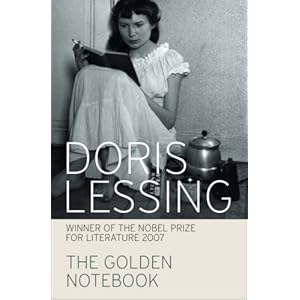
Frances and Laura's Unread Book Club: The Golden Notebook by Doris Lessing
I referred to the 92 year old author of this book as 'Doris fucking Lessing' yesterday. I think it was an appropriate response to a book that bored me, then pissed me off, and then bored me some more, and I doubt she'd mind. Much. Apart from the fact that I was reading it as a co-joint-ready thing with Frances, I would probably have given up on it weeks ago, condemned it to the darkened depths of my wardrobe (that's where I keep books that have failed me like Uncle Tom's Cabin and Oliver Twist) but as it was, I soldiered on, and from this place (the giddy heights of having actually finished the damn thing) I'm really glad that I did. But not because it was good.
Oh no. Because, despite what Nora Ephron had to say about it, I just can't get on board with basically any of the book, and I think I know why that is. It's time for me to face the fact that Nora is, in fact, 50 years older than me, and her experience as a woman in society is so radically different to my own, that this book, which she felt related so strongly to her experiences (and which I'm sure many women of her generation could also relate to)really has nothing to do with my own experiences. And, I'm sorry to have to say this, but there was so little of the 'struggles' Anna faced that I found exciting or interesting, or even worth mentioning, and I kind of felt bleurgh-ish about the whole thing. There were so many views that I found objectionable, a half-hearted adherence to communism that was pretty uninspiring, and actually, quite a big lack of the feminism I expected to find.
Allow me to explain. The novel basically chronicles the goings on inside the head of Anna Wulf, a woman divorced from her husband who still keeps his name (fab) and which she keeps in four separate notebooks because she sees a separation between the four, or maybe just because she can't really consolidate them all into one because she is 'cracking up' as she puts it. Interspersed with these are sections called 'Free Women' basically chronicling the lives of, what I think is a fictional Anna (although Anna is already fictional, of course) her best friend Molly, and the lives of all the people that circle around them, albeit in a different way to the stories we get in the notebooks. Actually, I can't really fault Lessing on form here- I did think the concept of someone keeping four notebooks because they can't keep themselves together anymore was a fascinating one, and the deeper narrative of Free Women was also good. In a way, it sort of made The Golden Notebook like the personal journey someone goes through before writing a novel, which in itself, is, I think, a noble subject.
My question then, really, is this: where are the 'Free Women'? I guess that, considering the novel is set in the late fifties (it was published in 1962, so I'd imagine it was written then, or just after, too) Anna probably have been seen as a free woman- she is divorced, lives only with her daughter, and has sex with men whenever she feels like it, which kind of seems to be not that often, but she might as well because, what else is there to do? It's frustrating to read a book purportedly feminist when Anna, when she's not thinking about herself and her state of mind and being sad, is attributing every feeling to men- her depression because the man she loves has left her (to go back to his wife, but more on that later), joy because she has had sex with a man that she might love, discomfort because a man might know she has her period (don't even get me started on that one) and on and on and on it goes. And here's the thing- Anna doesn't need a man, she manages well financially and everything on her own, and while I realise that feminism is not about not wanting men or anything like that, the fact of the matter is that the way Anna feels about herself is directly dependent on how men (or particular men) feel about her, and that I really can't stomach.
And now let's talk about those married men. Anna seems to mainly have sex with the married men, although she doesn't love them and doesn't even enjoy it when she doesn't, hence making herself into, essentially a sexual plaything for them; only being cast-aside when they're done doesn't bother her, and she feels absolutely no guilt for their wives who are left at home. This alarms me- Anna seems to adopt an attitude of every woman for herself, at odds with the communism that she believes is right politically, and light years away from the later second-wave feminists in the 60s. Instead of properly thinking about the women being betrayed, Anna sees them all as a type- dull housewives who clean and cook and sit around watching tv, and who are all of course frigid; rather than considering that they are women too, who could easily be in different circumstances and, you know 'there but for the grace of God is she'. Anna continually sees herself as better than these women, but where men are involved, they're exactly the same- the wives make the man's life easier by being at home and raising his children, while Anna, the mistress, makes his life easier by satisfying his sexual needs. What they do apart from men is here irrelevant- their relationship with men is equally as dysfunctional and unequal.
What I think is really sad about this book is that Anna doesn't fully realise the value of her relationship she has with Molly. Her friendship with Molly is the most stable and arguably meaningful relationship in her life (possibly eclipsed by the one with her daughter, but definitely more equal). I'm not saying that this should mean that Anna shouldn't want a man as well, but when she does have one, Molly becomes peripheral, almost unimportant to her, which to me seems ridiculous. In these situations, Anna puts such an emphasis on the physical aspects of relationships, when surely a relationship that is fulfilling in every other way should be immediately tossed aside when she finds someone who will have sex with her. There is no danger, I should add, of Anna and Molly becoming lesbians, since Lessing's attitude to homosexuality is one that made me really uncomfortable at times. Anna has a gay male lodger (which is cool of her, in the fifties, admittedly) but in exchange for his lodging, she takes it upon herself to judge him and generally have a completely negative attitude towards the way he chooses to live, although far be it for anyone else to question her life. It's a kind of hypocrisy, and it made me feel a little bit ill, to be honest.
In the end though, what's really wrong with The Golden Notebook is that all the notebooks are really all the same, just manifestations of Anna's inner thoughts, which are generally about herself and about men. Even when she's trying to write fiction, it's all about herself, and it's kind of a way to tell the same story in four different ways. Again, I think this is kind of cool in theory, and I can't fault the form which I think could have been really exciting, but honestly, it was just a little boring. As for it being a great feminist text, all I can really say is that we've come a long way, baby- The Golden Notebook-era feminism seems to be 'well, I'm all alone, so I can sleep with whatever men I want, even if they're married because I'm liberated... but I sure wish I had a husband to take care of me so I didn't have to think about stuff any more!' whereas, now, I feel like a husband is nice but not necessary, but also that a relationship between a man and a woman can be so much more equal. I mean, Anna's ex-husband doesn't appear at all in this book, and she doesn't even mention the fact that he never sees his child, which is something that is so frowned upon today, and also something which men would probably even take offence to- it's not a strange thing for men to care about and for their children, which they don't seem to do at all in this book. That's ok though, because this would probably make them not 'real men' something which Anna is very insistent about wanting, even if it leaves her in the subservient state that she is already in but can't see.
So, The Golden Notebook? I wouldn't bother. There are so many more books that are more relevant to feminism today, and without that to recommend it, I really just found The Golden Notebook too boring for words. If, however, a narcissistic (or arrogant, as one character in the book aptly describes it) stream of consciousness for 600 odd pages appeals to you, then go for it. Otherwise, just revel in the feminism of Jane Eyre or something, because honestly, I got a lot more out of that than out of The Golden Notebook.
Update: Frances's review is here- go read it because it's funny and pretty much sums up how little I liked this book in a much more concise way.
Oh no. Because, despite what Nora Ephron had to say about it, I just can't get on board with basically any of the book, and I think I know why that is. It's time for me to face the fact that Nora is, in fact, 50 years older than me, and her experience as a woman in society is so radically different to my own, that this book, which she felt related so strongly to her experiences (and which I'm sure many women of her generation could also relate to)really has nothing to do with my own experiences. And, I'm sorry to have to say this, but there was so little of the 'struggles' Anna faced that I found exciting or interesting, or even worth mentioning, and I kind of felt bleurgh-ish about the whole thing. There were so many views that I found objectionable, a half-hearted adherence to communism that was pretty uninspiring, and actually, quite a big lack of the feminism I expected to find.
Allow me to explain. The novel basically chronicles the goings on inside the head of Anna Wulf, a woman divorced from her husband who still keeps his name (fab) and which she keeps in four separate notebooks because she sees a separation between the four, or maybe just because she can't really consolidate them all into one because she is 'cracking up' as she puts it. Interspersed with these are sections called 'Free Women' basically chronicling the lives of, what I think is a fictional Anna (although Anna is already fictional, of course) her best friend Molly, and the lives of all the people that circle around them, albeit in a different way to the stories we get in the notebooks. Actually, I can't really fault Lessing on form here- I did think the concept of someone keeping four notebooks because they can't keep themselves together anymore was a fascinating one, and the deeper narrative of Free Women was also good. In a way, it sort of made The Golden Notebook like the personal journey someone goes through before writing a novel, which in itself, is, I think, a noble subject.
My question then, really, is this: where are the 'Free Women'? I guess that, considering the novel is set in the late fifties (it was published in 1962, so I'd imagine it was written then, or just after, too) Anna probably have been seen as a free woman- she is divorced, lives only with her daughter, and has sex with men whenever she feels like it, which kind of seems to be not that often, but she might as well because, what else is there to do? It's frustrating to read a book purportedly feminist when Anna, when she's not thinking about herself and her state of mind and being sad, is attributing every feeling to men- her depression because the man she loves has left her (to go back to his wife, but more on that later), joy because she has had sex with a man that she might love, discomfort because a man might know she has her period (don't even get me started on that one) and on and on and on it goes. And here's the thing- Anna doesn't need a man, she manages well financially and everything on her own, and while I realise that feminism is not about not wanting men or anything like that, the fact of the matter is that the way Anna feels about herself is directly dependent on how men (or particular men) feel about her, and that I really can't stomach.
And now let's talk about those married men. Anna seems to mainly have sex with the married men, although she doesn't love them and doesn't even enjoy it when she doesn't, hence making herself into, essentially a sexual plaything for them; only being cast-aside when they're done doesn't bother her, and she feels absolutely no guilt for their wives who are left at home. This alarms me- Anna seems to adopt an attitude of every woman for herself, at odds with the communism that she believes is right politically, and light years away from the later second-wave feminists in the 60s. Instead of properly thinking about the women being betrayed, Anna sees them all as a type- dull housewives who clean and cook and sit around watching tv, and who are all of course frigid; rather than considering that they are women too, who could easily be in different circumstances and, you know 'there but for the grace of God is she'. Anna continually sees herself as better than these women, but where men are involved, they're exactly the same- the wives make the man's life easier by being at home and raising his children, while Anna, the mistress, makes his life easier by satisfying his sexual needs. What they do apart from men is here irrelevant- their relationship with men is equally as dysfunctional and unequal.
What I think is really sad about this book is that Anna doesn't fully realise the value of her relationship she has with Molly. Her friendship with Molly is the most stable and arguably meaningful relationship in her life (possibly eclipsed by the one with her daughter, but definitely more equal). I'm not saying that this should mean that Anna shouldn't want a man as well, but when she does have one, Molly becomes peripheral, almost unimportant to her, which to me seems ridiculous. In these situations, Anna puts such an emphasis on the physical aspects of relationships, when surely a relationship that is fulfilling in every other way should be immediately tossed aside when she finds someone who will have sex with her. There is no danger, I should add, of Anna and Molly becoming lesbians, since Lessing's attitude to homosexuality is one that made me really uncomfortable at times. Anna has a gay male lodger (which is cool of her, in the fifties, admittedly) but in exchange for his lodging, she takes it upon herself to judge him and generally have a completely negative attitude towards the way he chooses to live, although far be it for anyone else to question her life. It's a kind of hypocrisy, and it made me feel a little bit ill, to be honest.
In the end though, what's really wrong with The Golden Notebook is that all the notebooks are really all the same, just manifestations of Anna's inner thoughts, which are generally about herself and about men. Even when she's trying to write fiction, it's all about herself, and it's kind of a way to tell the same story in four different ways. Again, I think this is kind of cool in theory, and I can't fault the form which I think could have been really exciting, but honestly, it was just a little boring. As for it being a great feminist text, all I can really say is that we've come a long way, baby- The Golden Notebook-era feminism seems to be 'well, I'm all alone, so I can sleep with whatever men I want, even if they're married because I'm liberated... but I sure wish I had a husband to take care of me so I didn't have to think about stuff any more!' whereas, now, I feel like a husband is nice but not necessary, but also that a relationship between a man and a woman can be so much more equal. I mean, Anna's ex-husband doesn't appear at all in this book, and she doesn't even mention the fact that he never sees his child, which is something that is so frowned upon today, and also something which men would probably even take offence to- it's not a strange thing for men to care about and for their children, which they don't seem to do at all in this book. That's ok though, because this would probably make them not 'real men' something which Anna is very insistent about wanting, even if it leaves her in the subservient state that she is already in but can't see.
So, The Golden Notebook? I wouldn't bother. There are so many more books that are more relevant to feminism today, and without that to recommend it, I really just found The Golden Notebook too boring for words. If, however, a narcissistic (or arrogant, as one character in the book aptly describes it) stream of consciousness for 600 odd pages appeals to you, then go for it. Otherwise, just revel in the feminism of Jane Eyre or something, because honestly, I got a lot more out of that than out of The Golden Notebook.
Update: Frances's review is here- go read it because it's funny and pretty much sums up how little I liked this book in a much more concise way.
Subscribe to:
Posts (Atom)